Now, more than 2 million Unstoppable domains can be used to easily build decentralized websites that are fully functional on Brave
We’re excited to announce that more than 2 million Unstoppable domains can now be used to display decentralized websites in Brave, a secure and privacy-centric browser that allows you to explore the Internet without being tracked. Through the Unstoppable Domains integration with Brave, creators can build decentralized content with a domain that they fully own and control – or explore the nearly 30,000 websites and counting that have been created using an Unstoppable domain. Now, we’re deepening our integration beyond .crypto to include more top-level domains – including .nft, .x, .wallet, .bitcoin, .blockchain, and .dao.
Over the past 50 years, the Internet has transformed our world and the way we communicate. But today, most people still surf the Internet using Web2 addresses that are rented, not owned. With Brave and Unstoppable Domains, launching a decentralized website couldn’t be easier, giving people an alternative to renting Web2 domains. Unstoppable domains are yours for life with no renewal fees, eliminating the risk of losing a domain because you forget to renew or because the registrar takes it away.
“Together with Unstoppable, we’re giving more people the power to create content and explore the Internet without sacrificing their privacy or their autonomy,” said Brendan Eich, CEO and co-founder of Brave. “We’re excited to expand access to the decentralized Web for our 60 million users and to contribute to a privacy-first Internet where people have ownership of their data.”
“Web3 is the future, and with Brave, we’re expanding access to the decentralized Web and giving people more ways to build their identity online,” said Sandy Carter, SVP and Channel Chief of Unstoppable Domains. “Brave’s Web3-ready browser makes it possible to build websites that are fully owned by people, not rented from big tech companies.”
Through the Brave integration with Unstoppable Domains, domains like Sandy.nft and Brad.crypto function just like normal Web2 addresses, but are hosted on the InterPlanetary File System (IPFS), a decentralized, peer-to-peer network. Brave offers a Web3-ready browser with native support for IPFS—meaning you don’t need to take any additional steps, or download any additional software, to access decentralized sites. Navigating to an IPFS URL is as simple as clicking a link or pasting it into the Brave browser’s address bar. Native support for IPFS is a key piece of infrastructure to offer truly decentralized websites where both the domain and Web content are owned entirely by the user and distributed across a network of nodes.
One domain, endless possibilities
An Unstoppable domain is your identity for Web3 – you can use it to receive cryptocurrency payments, log in seamlessly to apps, to send and receive emails, and now, to build your Web3 presence via a personal website. Creators can now build their identity on Web3 by creating a decentralized website with any Unstoppable domain.
With Unstoppable Domains and Brave, you can:
Build a personal blog or thought leader post (TimDraper.crypto)
Launch your NFT and create content for your community (DeadHeads.NFT)
Inspire the future of gaming (bizesports.x)
Build educational content and showcase your passions (Hashoshi.crypto)
Advocate and gather your community in one place (UnstoppableWow3.x)
Showcase your crypto podcast (0xJosh.NFT)
Create a platform to share your knowledge with the world (CryptoMoonWalkers.x)
Build your decentralized website
Interested in building your own decentralized website? Start by minting your Unstoppable domain. Once your domain is minted, you can add an existing IPFS hash, upload HTML directly from the Unstoppable Domains site, or create a new website through Web3 web builders such as Pazly. Then, you’re ready to launch a Web3 site and use it as your personal website or a decentralized backup to your Web2 site. There’s no fee to publish a website with your NFT domain – Unstoppable covers gas fees for hosting. You also don’t have to pay for a separate hosting company, which can cost up to $200 per year in the Web2 space. Learn more at Changetheweb.x – be sure to use the Brave browser to access.
We’re focused on building utility for NFT domains – Unstoppable Domains recently launched a new mobile app for Web3 identity management, integrated with Skiff to give domain holders end-to-end encrypted email, and now, we’re making it even easier to use your domain to build a personal website. We’re thrilled to take this step towards a more decentralized web and to help more people build their Web3 identity.
Like many in the crypto space, Bitcoin.com’s mission is to increase economic freedom for everyone. An important part of that is expanding access to financial products and services. DeFi, which enables open access to such products and services, helps create economic freedom — but in its current state, the power of DeFi is severely stunted. In this article, we’ll put forth our theory for what happened and how it can be solved. We’ll also describe what Bitcoin.com specifically is doing to make DeFi accessible to millions more people.
As the following chart shows, DeFi saw meteoric growth from summer 2020 (aka “DeFi Summer”) to approximately year end 2021 before stalling completely.
You might think this is purely a function of bull/bear market dynamics (after all, the stalling of growth pretty closely coincides with the move from bull to bear). However, while there’s certainly some of that at play, it’s very likely that this chart is telling us something deeper.
The reason for DeFi’s incredible growth is also the reason for its plateau. Prior to DeFi Summer, people steeped in crypto had an unfulfilled need for on-chain financial products and services. When DeFi’s usability reached an inflection point in summer 2020, crypto users with even a little bit of technological sophistication onboarded to the DeFi products available en masse. The entire cohort of users with sufficient technical prowess, but also necessarily high risk tolerance, had entered by the end of 2021.
DeFi is in a place now where there isn’t any appreciable influx of new users. This can be attributed to several factors; chief amongst them the difficult onboarding experience, unintuitive UI/UX interfaces of DeFi products, and the fact that the high risks associated with crypto in general are magnified in DeFi products. In order for DeFi to attract new users, it must overcome one or more of these problems.
Using DeFi is hard
To drive home this point, let’s take a relatively simple action: earning interest. Imagine, you’re a newcomer to the space with $5000 to deploy. It’s not a small sum of money, but if gas on Ethereum is above say 20gwei, any interest you earn will be consumed by your transaction fees, making the whole process pointless. This means you’ll need to use a low-fee chain like Avalanche, requiring you to bridge over and, if you haven’t already, set up your custom RPC for Avalanche on your wallet. Of course you’ll also need to swap into AVAX to pay for your transactions on the new chain, which means you’ll need to find a reputable DEX on Avalanche. Finally, you’ll swap into the actual assets you want to deposit into your chosen lending protocol, say AAVE.
While the above may be obvious to “crypto-natives,” newcomers would abandon the process before even starting because they wouldn’t even know where to begin. All of DeFi is like this, and it will never attract a wide audience in its current state. Ever.
Solution: a unified experience
What if a user was able to navigate the above process through one wallet app where much of the complexity is hidden. The experience could be something like this:
Click on the “earn interest” button and browse through different protocols with the range of their current rates. Select the “Aave” button because its rates seem appealing and indicated reputation is best-in-class.
The wallet presents you with interest rates on different assets on Aave, along with relevant information such as your current holdings.
You choose a cryptoasset like USDT. The app informs you that you don’t have this cryptoasset on this chain and asks if you would like to swap into the asset on this chain.
You say yes and are asked what amount should be swapped? You choose a cryptoasset to swap into. A swap rate and bridge time are given. You verify and, behind the scenes, the cryptoasset you chose to swap is bridged, swapped into USDT (if necessary) and added to the appropriate Aave pool.
This is the direction DeFi needs to go, but we’re still early in that journey — and between here and there, many pitfalls await. Let’s look at the typical journey of newcomers to space to examine those pitfalls:
Bitcoin is still the gateway to DeFi
Bitcoin is the original form of decentralized finance, and it’s still the biggest gateway to what we now think of as DeFi:
Click on the “earn interest” button and browse through different protocols with the range of their current rates. Select the “Aave” button because its rates seem appealing and indicated reputation is best-in-class.
The wallet presents you with interest rates on different assets on Aave, along with relevant information such as your current holdings.
You choose a cryptoasset like USDT. The app informs you that you don’t have this cryptoasset on this chain and asks if you would like to swap into the asset on this chain.
You say yes and are asked what amount should be swapped? You choose a cryptoasset to swap into. A swap rate and bridge time are given. You verify and, behind the scenes, the cryptoasset you chose to swap is bridged, swapped into USDT (if necessary) and added to the appropriate Aave pool.
This is the direction DeFi needs to go, but we’re still early in that journey — and between here and there, many pitfalls await. Let’s look at the typical journey of newcomers to space to examine those pitfalls:
Bitcoin is still the gateway to DeFi
Bitcoin is the original form of decentralized finance, and it’s still the biggest gateway to what we now think of as DeFi:
74.5% of people have heard of Bitcoin, more than 3 times as many people as the next most widely recognized cryptocurrency (DOGE). Not only that, but Bitcoin recognition is also more diverse than any other cryptocurrency. In fact, it’s the only major crypto where more women have heard of it than men (in the U.S). By comparison, 3 times as many men than women have heard of Ethereum.
Looking at ownership, despite the existence of tens of thousands of cryptocurrencies, 65% of crypto users hold Bitcoin.
So, what brings people to Bitcoin?
People are attracted to Bitcoin for many reasons — some ideological, some practical — but the majority are interested in making a profit. They hear about number go up, and they want in — and that’s fine!
Of course, when investing is your primary motivation, taking self-custody of your Bitcoin/crypto is unlikely to be highly important for you. This leads us to the first major pitfall:
The pull of centralization is strong
The majority of users don’t self-custody their assets. Actually there are more than 3 times as many users of centralized exchanges than users of self-custody wallets.
What we have here is a kind of paradox where most people who hold Bitcoin, the original form of decentralized finance, are using it in a centralized way. If your entry point to “decentralized finance” is a centralized platform, this can lead to certain…. problems.
Because DeFi is hard, entrepreneurs have tried to make it easy. That’s great. Decentralized Finance is something that shouldn’t be available to whales and techies only. Unfortunately, the latter half of the last cycle saw the rise of what can be called “Centralized DeFi” (an oxymoron if there ever was one). Here we refer to the centralized platforms that took custody of people’s assets, offering them exposure to the yields available in DeFi without any of the hassle. The UX was sweet: just send your crypto over and start earning interest. No need to move your assets between lending protocols in your chase for the highest APY. No need to rebalance your AMM pools to avoid impermanent loss. No bridging, no Discords; none of the hard parts of DeFi. Perhaps unsurprisingly, it was widely successful.
Unfortunately, it didn’t end well.
Billions of dollars were frozen and thousands of people lost their life savings on centralized platforms like Celsius and Voyager ($4.7 billion and ~$1 billion respectively).
This is not to say that “real” DeFi is devoid of dangers. In fact, the dangers are many. Just ask anyone who held UST.
Protocol risk is real
It didn’t matter whether held in custodial or self-custodial wallets, UST went to zero for the holder in both cases. $45 billion evaporated almost over night, and again, thousands lost their life savings.
Protocol risk, as it is euphemistically known, stems from a variety of factors including bugs in code, incompetent coding (the code is acting exactly as intended, but with unintended consequences), malicious actions of the developers, and so on. Protocol risk can result in hacks where just a small percentage of assets are stolen, or it may result in the total collapse of a project (with the value of its associated tokens going to zero) as was the case with UST and the Terra ecosystem.
For most public financial products, the government regulates and in many cases insures people against institutional failure. This is not the case in crypto.
Bitcoin like is was meant to be
Bitcoin.com is naturally a key entry point for newcomers to Bitcoin, and therefore for newcomers to crypto broadly. As stewards of the domain, we have a responsibility to get it right. Our mission is to create economic freedom, and we believe that self custody is critical for that.
But self custody is a paradigm shift, and it’s hard. Most people don’t even understand what it means much less realize the positive implications (like censorship resistance and elimination of 3rd-party risk) OR the consequences (like losing your funds if you lose your key).
As with all paradigm shifts, the new thing has to be way better if people are going to make the effort to change their behavior. Just like electric cars have to be just as good as, if not better than gas-powered cars, self custody has to be at least as easy as centralized custody. Acknowledging that we still have a long way to go, this is what we’re trying to do at Bitcoin.com.
When newcomers download the self-custodial Bitcoin.com Wallet, they’re provided with educational materials on the importance of self-custody and the option to back up their private keys to the cloud. The latter eliminates the need to manage multiple seed phrases, one for each of the 3 chains we currently support.
This type of onboarding experience, we hope, sets people up for success on their crypto journey. They’ll self-custody assets from the start, gaining knowledge that is useful in the web3 world.
Bitcoin.com’s VERSE token: widening the gateway to DeFi
There’s a huge gap between getting your first crypto and safely engaging in DeFi. On that journey, UI is critical, and education is good, but incentives also have incredible power. Here’s where we think a rewards and utility token will play a big roll in onboarding newcomers to DeFi. For the Bitcoin.com ecosystem, this will take the form of VERSE, which will be rewarded to users as they progress on their journey. For example, they will be incentivized to back up their self-custody wallets securely, to learn a little more about crypto beyond Bitcoin, to make their first trade, and so on. With a gamified experience, people can be have fun on their journey to becoming DeFi natives — remembering that the goal is to empower people to have the skills and knowledge needed to take full advantage of decentralized finance and the economic freedom it creates.
We’re just getting started with Verse, but we see it as central to the Bitcoin.com ecosystem. Along with Bitcoin itself, we envision Verse to be the world’s gateway to DeFi. Learn more at getverse.com, where registrations are now open for the token sale, which goes live on November 1st.
Whenever you make a transaction on the Ethereum network, you need to pay a fee. This fee goes to crypto miners for the computation needed to execute the actions associated with the transaction and to write them in the blockchain.
In order to determine exactly how much work a certain action takes, an internal pricing unit called gas is used. A simple transaction doesn’t require as much computational power to be written into the blockchain as a smart contract or a decentralized application (dapp). Consequently, the former takes just a little bit of gas, while the latter two can take a lot of gas.
Gas is paid for in ether (ETH), Ethereum’s native cryptocurrency. There is no 1:1 correlation between them; instead, users themselves determine how much they are willing to pay for gas in order for their actions to be executed. The higher the price, the more eager the miners are to prioritize that action.
GAS ESSENTIALS
Gas is a unit of the internal pricing system for executing all actions in the Ethereum blockchain.
It represents the amount of computational work needed to write a simple transaction, or the result of a smart contract or a DApp into the blockchain.
Gas is paid for in ether, Ethereum’s native cryptocurrency.
Each user determines how much they are willing to spend for every unit of gas.
The higher they set the price, the faster miners will pick their transaction from the mempool.
Why do you need gas?
Because of Ethereum’s nature of public trades and transfers, the market price of ether can change very quickly. That is why an internal pricing system is used to keep the fee of transactions relatively stable compared to the fast-changing market price of ether.
As an example, imagine that the fee for running a transaction was paid at the static cost of 0.1 ETH. When the market price for 1 ETH was 10 USD, you needed to pay 1 USD for a transaction. But if the price of 1 ETH rises to 1,000 USD, you would need to pay 100 USD for that same transaction.
That is why an internal pricing unit called gas was created. It stabilizes the cost of transactions by decoupling it from ether’s ever-changing market price.
How much gas do you need?
All transactions on the Ethereum network need computational power to be executed. Each action has an associated gas cost, be it a simple transaction, smart contract or even a DApp. In general, the amount of gas required for the action is directly proportional to the amount of work necessary to write it into the blockchain.
When making a transaction, your wallet usually gives you a rough estimate for how much gas it will take. It is then up to you to determine how much you want to pay for that gas. For instance, if your transaction takes 21,000 gas and you’re willing to pay 5 Gwei (0.000000005 ETH) per one unit of gas, you will pay a total of 0.000105 ETH in fees which, at the current exchange rate, means a single US cent.
Transaction gas limit
You can never be quite sure exactly how much work an action will take. So, instead of attaching a precise fee or allowing the fee to adjust automatically, you set a gas limit. This is the highest amount of gas you are willing to spend on a transaction. Combined with the gas price, the gas limit effectively determines the highest amount of ETH that can be potentially spent on the transaction. All of the gas that isn’t spent on writing the transaction into the blockchain is refunded back to your wallet.
gas price × gas limit =maximum cost (in ETH)
If you set a precise fee and it turns out that it cannot cover the computational expenses, you’ll end up with a failed transaction, for which you still have to pay the price you’ve set. The idea is that the miner who has included your transaction in the block has done as much work as they could for the given price.
If you allow the fee to adjust automatically, you run the risk of depleting all your funds in case the smart contract that you are interfering with has a buggy code or infinite loops, which would make it much bigger, and consequently much more expensive to write into the blockchain, than initially anticipated. With a gas limit, you avoid both problems, since it more or less ensures your transaction fees are covered, and protects you from losing all your funds if something goes wrong.
Note that transaction gas limit is not the same as block gas limit, which is Ethereum’s way of controlling block size.
Optimal gas price
It should be noted that miners can choose which transactions to process first and will usually prioritize transactions with a higher gas price. This is because miners use their own time, electricity and computational power when writing your transaction in the blockchain and they are looking to make their work as profitable as possible.
Setting the right gas price and gas limit ensures your transaction gets mined and added to the blockchain at the optimal price-to-time ratio. A transaction with too small a fee may never be included in a block, while a transaction with too large a fee may be a waste of money, as it gives no particular time advantage over an average fee.
When transacting in ETH on the Bitstamp exchange, you do not need to worry about gas, since the exchange covers all fees incurred by crypto trading for free. The only fees you need to pay when buying items or services with crypto, or simply transferring crypto funds to another address, are the exchange’s own fees – and these are fixed. Creating an account at Bitstamp is free of charge.
The Bitcoin protocol is subject to regular updates aimed at upgrading the protocol, addressing flaws and resolving security issues. Since its inception in 2009, many upgrades have already been successfully implemented. One of the more notable upgrades dealt with so-called transaction malleability, which made it possible for attackers to indirectly modify transaction IDs.
The solution implemented to fix transaction malleability is referred to as Segregated Witness, or SegWit. This article explains how SegWit stopped transaction malleability and outlines SegWit’s extended functionality, which made it possible to introduce many different types of scaling options (read this article to learn about blockchain scaling).
SEGWIT ESSENTIALS
Segregated Witness, or SegWit, is a protocol implemented to fix transaction malleability which allowed for transaction IDs and hashes to be modified.
SegWit virtually increases block size four times with the block weight concept.
SegWit reduces transaction fees.
Its design was proposed in Bitcoin Improvement Proposals (BIPs) 141, 148 and 91.
SegWit makes it possible to set up Schnorr signatures and facilitates the implementation of the Lightning Network.
Design and development
SegWit was conceptualized and presented by developer Pieter Wiulle at the Scaling Bitcoin conference in December 2015, where the primary topic was making Bitcoin grow bigger and faster. With the promise of opening the door to Bitcoin scaling, SegWit immediately garnered substantial community support.
The design of SegWit was first outlined in Bitcoin Improvement Proposals (BIPs) 141 and 148. Its initial purpose was to address the ability to change signatures and, consequently, transaction IDs, which is commonly referred to as transaction malleability. This was a flawed piece of code that allowed anyone to alter small transaction details to modify a transaction hash, which also changed the transaction ID.
And while transaction malleability allowed for the modification of transaction ID, it did not enable the contents of BTC transactions to be changed. As it only allowed for the transaction ID and hash to be altered, transaction malleability never really posed a major risk to the Bitcoin protocol. It did, however, inhibit the development of more complex features, for instance various scaling solutions and smart contract functionality.
In addition to fixing transaction malleability, SegWit also reinvents the concept of block size. While the size of blocks in the Bitcoin blockchain was traditionally limited to 1 MB of data, SegWit builds upon this with a new concept termed block weight. With block weight, each block has a limit of 4 M weight units, or 1 M vbytes, meaning that 1 vbyte equals 4 weight units. As a result, nodes with software updated with the SegWit protocol can potentially send and receive four times the amount of data they could before the SegWit soft fork. However, due to various constraints, blocks are never that large – the average block size revolves around 1.3 MB.
This redesign of block size also results in lower transaction fees. Before SegWit, transaction fees were determined as fee per transaction size. With the introduction of the block weight concept, this changed to fee per weight unit. As SegWit reduces the burden on the blockchain, fees required for the validation and addition of transactions to the blockchain are reduced accordingly.
To test its functionality, SegWit was first activated on Litecoin on 10 May 2017. Once it proved to be operational, it was also implemented on Bitcoin on 23 August 2017. Since it was implemented by means of a soft fork, the blockchain is compatible with the nodes that do not support SegWit. This means that full nodes in the Bitcoin network will have the same copy of the ledger, regardless of how large their blocks are.
A foundation for scaling
Once SegWit was put in place, it enabled new scaling methods in terms of both on-chain and off-chain scaling solutions.
SegWit makes it possible to implement Schnorr signatures. A Schnorr signature is a digital signature created by the Schnorr signature algorithm. Its security is based on the intractability of discrete logarithm problems. As it is short, it takes up less space on the blockchain than a traditional signature. This reduces the load on the blockchain and increases the network’s throughput by means of first-layer scaling.
But perhaps a more interesting feature unlocked by SegWit is layer 2 scaling. The malleability fix has opened the door to the safe implementation of the Lightning Network. Lightning is a separate network that combines channels between different network users and the six-degrees-of-separation principle to connect users who have not yet transacted before. The technology requires that only the starting and final balance of the channel has to be written to the blockchain, but none of the transactions in between. This unburdens the blockchain, reduces transaction fees and increases the network’s speed.
The implementation of SegWit was a key stepping stone in enhancing Bitcoin scalability. It has far outgrown its initial design (eliminating transaction malleability) and proved to be essential in supporting the ever-growing masses using the largest cryptocurrency. As of writing this article, over half of bitcoin transactions have adopted SegWit, with the number projected to grow in the future.
The Ethereum blockchain could be described as a blockchain with a built-in programming language. Alternatively, it could be defined as a consensus-based globally executed virtual machine. The part of the Ethereum protocol in charge of all the computing is known as the Ethereum Virtual Machine (EVM).
The EVM is key in Ethereum being able to run smart contracts. Smart contracts enable Ethereum to harness the power of decentralized applications (dapps). Additionally, smart contracts enable companies to hold so-called ICOs, or initial coin offerings, on the Ethereum blockchain in order to launch their own tokens.
ETHEREUM VIRTUAL MACHINE ESSENTIALS
The Ethereum Virtual Machine (EVM) is a runtime environment for smart contracts that is also used for developing and testing smart contracts.
The EVM is quasi-Turing complete, meaning it can perform any calculation as long as the user initiating the calculation has enough ether to pay the fee required for that calculation.
The EVM is a sandboxed and isolated environment, meaning that the code it runs has no access to the network, filesystem, or other processes.
Additionally, the EVM cannot access real-world data, e.g. the current date, time or weather. To acquire such data, it relies on so-called oracles.
The EVM is run by all full nodes of the Ethereum network.
Environment for developing smart contracts
The EVM is sandboxed and isolated from the real world. What this means is that the code running in the EVM has no access to a network, file-system, or any other processes. This makes the EVM perfect for developing and testing smart contracts without interfering with the operations of the blockchain.
You might be asking yourself why it is a good idea to test smart contracts in a sandboxed environment. The thing is that flawed code can be detrimental to any smart contract, so making sure that there are no flaws in the smart contract code is a must. What is more, a sandboxed environment such as the EVM provides infinite opportunities to learn, iterate, improve and eventually complete robust smart contracts that are ready for deployment to the blockchain.
Limitations of the EVM
The Ethereum Virtual Machine is described as Turing complete. Turing completeness refers to a computer’s capacity to perform any calculation it is presented with. This means that, in Ethereum, it is possible to write programs or decentralized apps that are capable of solving any reasonable computation.
But there is a limitation to the EVM, and it is there as a kind of safety precaution. Smart contracts can call other contracts, potentially allowing for infinite looping. The EVM accordingly demands a gas fee to be paid for each on-network transaction. This means that infinite computational loops are prevented by exhausting initiating transactors of their ether. On account of this safety measure, the EVM cannot be entirely Turing-complete. Rather, it is said to be quasi-Turing complete.
Another thing worth mentioning is that the EVM cannot access even the most basic of real-world data. For example, the EVM cannot know on its own what day it is or tell the current temperature. To acquire such data, which is often required for the proper execution of smart contracts, the EVM relies on real-world data providers known as oracles. An oracle can gather data from a website, an app or elsewhere, and feed it to the smart contract.
What does the EVM do?
Whenever a transaction is initiated on the Ethereum blockchain – and it does not matter whether it is a simple transfer of value or a smart contract deployment – the EVM must perform the following three checks:
It confirms whether a transaction has the correct number of values, whether the signature is valid, and whether the transaction nonce matches the nonce of that particular transaction account. In case of a mismatch, the transaction prompts an error.
It calculates the fee required for the transaction and initializes the gas payment.
It executes the transfer of the ether or tokens to the assigned address.
Should the EVM detect that the sender did not allocate enough gas to the initiated transaction, the transaction will not be successful. In this case, the transaction fee is not refunded to the initiator of the transaction. Instead, it is paid to the miner. However, if a transaction is unsuccessful due to an error on the recipient’s address, the EVM will return the amount sent as well as the associated fee back to the sender.
EVM is where the magic of Ethereum happens, bringing added value to blockchain technology and the world of cryptocurrencies. On account of features such as the EVM, the Ethereum platform has enjoyed great popularity, with ether, its native crypto, remaining one of the largest cryptocurrencies by market cap.
Since Satoshi Nakamoto mined the Bitcoin genesis block in 2009, the Bitcoin blockchain has gone through numerous updates and changes aimed at mending its shortcomings and improving the protocol’s overall functionality. These updates and changes are outlined as proposals and are commonly referred to as BIPs, which is short for Bitcoin improvement proposals.
In essence, BIPs are design documents that lay out the features or information to be added to or changed in the protocol. They are designed by developers and then subsequently voted on by miners. A BIP is passed and incorporated into the protocol if it is upvoted by at least 95% of Bitcoin’s mining community.
BIP ESSENTIALS
A Bitcoin improvement proposal (BIP) is a document specifying the features and information to be integrated into the Bitcoin protocol.
There are three types of BIPs:
Standards track BIPs – alter the protocol or transaction and block validation;
Informational BIPs – draw attention to design issues and general guidelines;
Process BIPs – propose changes to the process.
BIPs must go through the following stages to be activated:
Review by an editor;
Approval by the miners;
The community must upgrade to the new protocol version to benefit from the BIP’s novel functionality.
Three types of BIPs
There are three major types of Bitcoin improvement proposals that differ from one another in terms of the improvements they describe or propose. The three different types are as follows:
Standards track BIPs are BIPs used for making changes to the network protocol or to the methods of transaction or block validation. Standards track BIPs are also aimed at optimizing the interoperability between the two versions of the Bitcoin protocol that coexist in the event of a fork. This type of BIPs always require community consensus.
Informational BIPs are BIPs that draw attention to design issues, general guidelines and supporting information. Informational BIPs, as the name itself suggests, are only there for information’s sake. It does not matter whether the community takes them seriously or ignores them altogether.
Process BIPs are BIPs that describe or propose a change in the process. They are similar to Standards track BIPs and require community consensus. They cannot be ignored, but unlike Standards Track BIPs, they are applied outside the Bitcoin protocol.
Soft-fork and hard-fork BIPs
Like any blockchain software modification, BIPs require the Bitcoin blockchain to be forked in order to be implemented. They can be implemented with either a soft fork or a hard fork, depending on whether the proposed change retains compatibility between the branches. A BIP that is introduced by means of a soft fork retains the cross-compatibility of different blockchain versions, whereas a BIP that requires a hard fork does not.
However, BIP forks should not be confused with user-activated forks. While both types of forks implement protocol upgrades, their adoption process differs greatly. Hard-fork BIPs, for instance, require the entire Bitcoin economy to adopt the proposal, whereas user-activated hard forks (UAHFs) do not. It can be noted that, to date, no hard-fork BIPs have yet been implemented, which is why this article focuses predominantly on soft-fork BIPs.
And while the decision on whether to adopt a hard-fork BIP lies in the hands of the Bitcoin economy – i.e. all BTC wallet owners and merchants who support BTC payments – soft-fork BIPs work differently. The adoption of soft-fork BIPs is up to miners. They can express their support for a certain BIP by including relevant data in the blocks they have mined. A soft-fork BIP is considered to have been approved if at least 95% of miners on the Bitcoin blockchain adopt the proposal.
Once approved by miners, a soft fork is implemented which introduces a stricter set of rules. To be able to use the novel functionality proposed in the BIP, the community (this includes miners, full nodes, exchanges, payment service providers, etc.) will have to upgrade their software to the new version.
Each BIP is assigned a label which specifies the status of that BIP. A BIP receives its first status, i.e. “Draft,” once it has been checked by the first editor. Then, the author may assign the label “Deferred” or “Withdrawn.” Alternatively, a BIP labelled “Draft” may also receive the label “Rejected” or “Approved” from the network community.
For a soft-fork BIP to be labeled “Final,” the following three criteria must be met (according to BIP-009):
The BIP follows the correct format as specified in BIP-1;
The BIP includes code implementations of the proposed changes to the protocol;
The BIP has 95% support from the last 2016 miners (these span over the past period of approximately 14 days’ worth of mining 10-minute blocks).
Over 130 BIPs have been proposed as of the writing of this article. The entire history can be accessed at this link.
Notable examples of BIPs
The first BIP to have been implemented was BIP-1. It was submitted by Amir Taaki in 2011. It provided a detailed presentation of what BIPs should look like, defining the format and structure of all the BIPs to come.
Perhaps one of the most notable Bitcoin improvement proposals was Segregated Witness, or SegWit. First presented at the Scaling Bitcoin conference in December 2015, SegWit was outlined in BIP-91, BIP-141 and BIP-148. Its aim was to fix transaction malleability and make it impossible to modify transaction IDs. With the soft-fork threshold at 95%, SegWit was successfully adopted by the Bitcoin mining community around mid-September 2017. Having fixed transaction malleability, Segregated Witness made it possible to develop theLightning Network, a layer 2 solution designed specifically for Bitcoin (and altcoin blockchains).
Another notable example is Merkelized Abstract Syntax Tree, or M.A.S.T., which was outlined in BIP-116 and BIP-117. M.A.S.T. is a cryptographic tool that enables complicated data sets to be added to the data associated with Bitcoin transactions. While M.A.S.T. makes it possible to further specify data, it simultaneously reduces the amount of data that needs to be recorded on the blockchain.
With ongoing developments in terms of BIPs, the Bitcoin community tries to make the Bitcoin protocol run as smoothly as possible. In addition to the fact that bitcoin is the largest cryptocurrency by market cap, it is also this continuous development that makes the rapidly-evolving and expanding blockchain network so attractive to crypto traders.
ZenGo is introducing a Web3 firewall: A new paradigm for safe and secure web3 transactions. In 2022 alone nearly $2 billion of NFTs and cryptoassets were stolen in malicious hacks affecting even hardware wallets. ZenGo’s Web3 firewall, ClearSign, informs, alerts, and protects ZenGo users against approving the most sensitive and vulnerable Web3 attacks. Combined with ZenGo’s MPC security architecture that removes private key vulnerabilities, ZenGo continues to innovate as the most secure crypto wallet in Web3.
A new paradigm in Web3 Security: ClearSign Firewall
Web3 feels like a highway without stoplights. Transacting in Defi and NFTs feels like being blind in a risky road with likely accidents and wallets make no effort to properly inform you and protect you about those risks. That can no longer be the case.
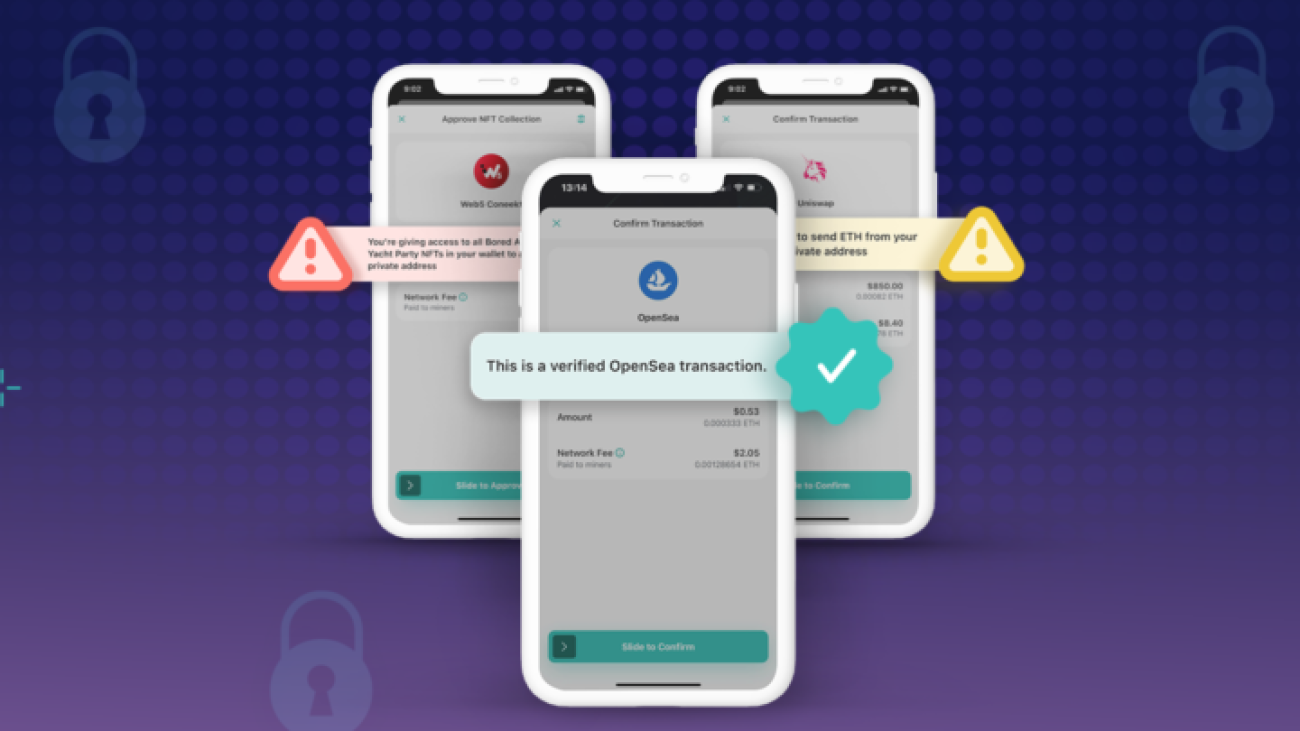
ZenGo’s ClearSign technology classifies sensitive on-chain transactions a user makes into 3 risk levels, based on transaction sensitivity, levels of permission granted to external systems, and known scams. Just like a stoplight, with 3 levels of safety.
Green: This interaction is with a verified Dapp and/or known smart contract.
Yellow: This interaction is context-dependent but generally reflects uncommon behavior: Stay alert and confirm that intent is aligned with expected results.
Red: ClearSign has detected highly unusual behavior and immediate attention is required. Most of the most sensitive red transactions require a double-confirmation.
ZenGo is integrating leading Web3 Dapps and known smart contracts to confirm when you are connecting to original contracts, and not fake or phishing websites that try and confuse you into giving away your assets. Look for the green checkmark during the signing process.
Verified smart contracts: ZenGo has incorporated verified smart contracts on dapps like OpenSea and UniSwap to provide the clarity and assurance that you are interacting with the legitimate dapps’ smart contracts.*
Signatures: Sometimes a Web3 dapp will request you to “sign” something. These types of actions are context-dependent: Sometimes they are harmless, and other times they have been used to steal assets from users.
This can be a stressful moment for many. WHAT are they asking, and how can you be sure that the request you are approving is a benign signing request – and not a more nefarious attempt to gain access to assets in your wallet?
Do you intend to simply sign and authenticate a general message? ZenGo has verified Dapp signing requests from Dune, CollabLand, and others as benign – and will be adding additional dapps in the future.
Some transactions are potentially suspicious, others are absolutely fine: Many times it depends on the context of the transaction and your intention. Millions of dollars have been stolen in transactions because it was unclear to the user what they were approving. ClearSign brings a new level of transparency and clarity to these types of transactions:
Do you intend to send or transfer your crypto or NFTs to a private address, when you thought you were actually engaging with a Web3 dapp smart contract?
If the answer is yes – great: Go ahead. But if the answer is NO: Then this ClearSign alert might just save you from losing millions of dollars 💪
Phishing alert! At first glance, the above Dapp might appear to be Uniswap. But look again: ClearSign alerts you: It’s Uniswapp – and it’s trying to do something unusual.
Red Alerts: Warnings against giving access to your wallet
One of the most harmful security hacks is when a user grants a malicious actor access to their assets (tokens or NFTs). This happened in countless phishing scams, including the phishing scam that resulted in Seth Green losing his Bored Ape.
Do you intend to grant access to your crypto wallet? ClearSign is constantly monitoring security at the smart contract level – if a Dapp is hacked and suggests you grant wallet access to a private address (instead of a smart contract), ClearSign will alert you before you make a mistake.
Phishing alert! ClearSign alerts that this 1) Isn’t a smart contract but rather a private address, and 2) It’s trying to access your entire account – highly suspicious!
MPC = Ultimate Wallet Security: Why ZenGo is the most secure crypto wallet in Web3
Over $100 billion dollars of bitcoin has been lost or stolen in the last decade because of poor private key and seed phrase management. Are your assets safe? Recoverable if your phone is lost or stolen?
Ultimately, all traditional crypto wallets have the SAME vulnerability: Private keys, which represent a single point of failure. From browser-based wallets like Metamask to hardware wallets like Ledger, every traditional crypto wallet relies on the same vulnerable security architecture.
ZenGo is different. ZenGo’s baseline security architecture leverages MPC instead of private keys, meaning your crypto and NFTs can’t get lost or stolen when seed phrases are exposed: Because your wallet does not have a seed phrase to get exposed! Learn more about ZenGo and MPC here, and realize why your ZenGo wallet offers the ultimate in Web3 simplicity and security.
A note to App developers:
No integration required on your end; ClearSign is deployed by ZenGo and can be fully-integrated with virtually no development support by the Dapp.
ZenGo is continuing to integrate verified dapps. To add your Dapp to the waitlist, contact us: partner@zengo.com.
*ClearSign Safety Disclosure: ClearSign is not a replacement for common security practices, including hacks and scams practiced via social engineering. Always be careful about transactions made to untrusted parties on social networks or entities that might be impersonating people, companies, or trusted brands you know. Phishing is and will continue to be a vulnerability that no technology can 100% prevent. This does not serve as financial advice nor assurance of any project’s longterm legitimacy or viability. As always, do your own research.
There’s one important question left to be answered.
When we talk about how fiat currencies are “unstable,” this simply means that there is room for instability within the structural design of fiat currencies — that governments can be corrupted and make poor fiscal decisions such as printing exorbitant amounts of money. But there remains a concern for instability in bitcoin, in that the price of bitcoin fluctuates too much for it to be used as a day-to-day currency.
There is a difference between the instabilities here — Bitcoin is secure, fiat is insecure; bitcoin is volatile, fiat is relatively stable in price(at least in powerful nation-states). In order to actually use bitcoin the way we currently use fiat one day, it needs to be stable. So, the question remains: How can we ever enforce a bitcoin standard if the price in terms of fiat dollars fluctuates so much?
Will Bitcoin Replace Fiat?
There are a few hypothetical scenarios that could play out. Some people think fiat will never disappear, while others think that bitcoin will completely overturn the existing financial system. Whatever happens, one thing remains true: Bitcoin is here to stay and will continue to play an increasingly prevalent role in our global financial system.
Realistically, bitcoin will not do a complete overhaul of fiat. However, anything is possible, and it’s a scenario that hasn’t played out before which is why it’s so hard to imagine. If bitcoin were to replace fiat, it would likely require the good-will of worldwide governments to concede to a decentralized currency. Knowing anything about any of our governments, it’s a highly unlikely scenario.
Instead, the path to global adoption will look more like individuals choosing self-sovereign stores of wealth. Keep in mind that because Bitcoin is permissionless, taking the right privacy measures means you can use and hold bitcoin even where outlawed.
Most likely, we will continue treating bitcoin as a store of wealth — an asset like real estate or stocks — that we can utilize in conjunction with the legacy lending system. By storing a portion of bitcoin as collateral, people can borrow fiat money to pay for day-to-day living expenses. There are a few lenders in some countries who have released this capability already.
CBDCs: Central Bank Digital Currencies
Many politicians have called for the implementation of CBDCs — a centralized digital currency — that would allow governments to retain their central authorities over monetary policies. This, if implemented, may come with less privacy than the cash system we still use today.
They foolishly think that this will kill the cryptocurrency industry as a whole. However, because so many people are afraid of CBDCs like the digital yuan potentially exercising privacy and personal security violations, this may well push bitcoin adoption forward as people seek the only truly self-sovereign money solution out there.
The Bitcoin Standard
When we think about the volatility of bitcoin, we think about it in terms of dollars, or whichever other fiat currency is native to us. But if we were to truly adopt a bitcoin standard — without fiat in the picture — then…what exactly are we comparing bitcoin’s price to? Is one bitcoin today not still one bitcoin tomorrow? Are 50 sats not still 50 sats?
As technology advances, our consumer goods naturally become cheaper — deflationary, if you will. As central governments strive to manipulate markets and prevent deflation at all costs, I implore you to think about the true alternative that bitcoin allows. If our current system is so broken, why are we still trying to break it? For more reading on this topic, I encourage you to read “The Price of Tomorrow”, **by Jeff Booth.
Over the last three weeks, we’ve taken down our fiat walls and opened the door to true sound money. This is just the beginning of your Bitcoin journey, and you have so much left to learn.
Bitcoin is our newfound grace — and all we know since our fiat days is, everything has changed.
Wait, don’t go! It doesn’t have to be over quite yet…. Continue the conversation on Twitter with #21DaysofBitcoin
If you’ve dabbled in the cryptocurrency world, you might know of bitcoin as a “store of value,” and ether (the Ethereum Network token) as the “smart contract thing.”
Yes, you can build cool stuff on Ethereum. You can write “smart” and programmable contracts. You can mint NFTs. You can create entirely new decentralized finance (DeFi) ecosystems on Ethereum and come out with your own tokens if you wanted to.
But ultimately, none of that cool technology that’s sitting on top of the Ethereum blockchain or any other blockchain project matters in the long-run. Why? Because the next generation of the internet should and will be built on Bitcoin instead.
Creating a Decentralized Web
Bitcoin doesn’t need to operate the way that Ethereum does. It works all on its own as a decentralized digital currency, and many people think that’s enough; bitcoin has a simple investment thesis and there’s no need to innovate beyond that when it comes to treating bitcoin as a store of value and high growth asset.
However, problems remain regarding the centralization of the infrastructure built around bitcoin — this includes exchanges and lending platforms that are centrally hosted and remain under the threat of jurisdiction. This creates barriers to entry (unequal distribution based on borders) that could be fixed with a new, decentralized internet infrastructure.
As we went over last week, Bitcoin is the ultimate blockchain protocol to build the next generation internet on, due to its incumbent status as the most secure and decentralized network of any cryptocurrency. Therefore, it only makes sense to innovate DeFi on Bitcoin.
How Will This Happen?
There is an entirely separate technical deep dive required for one to begin understanding the DeFi universe, but the simple reason for why Bitcoin-native DeFi is so far behind is due to its initial design. Other cryptocurrency networks like Ethereum and Solana were built with the intent to create DeFi and Web3.0, but Bitcoin remains simply as a sound monetary network.
While it is difficult to “upgrade” Bitcoin natively, developers can create BIPs (Bitcoin Improvement Proposals) to formally suggest improvements to the core software. However, due to this decentralized process (that makes bitcoin so secure in the first place), it is a difficult and lengthy journey to implement new features such as user-friendly complex smart contract capabilities (which are currently being worked on, such as via BIP-119!).
So instead, many companies and developers are creating layered solutions to help advance Bitcoin’s features, while continuing to secure these projects on the native Bitcoin blockchain. The Lightning Network is one such layer 2 example, and there are other solutions such as Blockstream’s Liquid side-chain or projects like Atomic Finance, SuredBits, Sovryn or HodlHodl.
Remember — there are different sets of tradeoffs and risks associated with each project. Always do your due diligence before using any new tools. This is not investment advice. Don’t trust, verify.
Why The Decentralized Internet Should Be Built On Bitcoin
As we progress into the next generation of the internet, it’s important that we do it securely—and that means building on Bitcoin. Building decentralized projects on centralized, proof-of-stake ecosystems (like Ethereum 2.0) means tolerating the existing financial infrastructures and re-packaging them into “blockchain technologies,” that gleam and glisten on the surface, while centralized stake-holders and those at the top dictate network changes. Additionally, those using the current Ethereum ecosystem must deal with astronomically high fees that often don’t warrant the lower-scale transactions being made.
If we are to make proper decentralized improvements to our existing digital and financial systems, we should do it properly, from the beginning. Use your best colors to paint the portraits of progress on Bitcoin’s canvas. In the end, these are the works of art that will stand the test of time.
Discuss DeFi on Bitcoin with the brightest minds in the space. Tweet your questions with #21DaysofBitcoin!
Bitcoin is the original cryptocurrency. Since its genesis in 2009, countless DeFi projects and altcoins have popped up; from Dogecoin to ETH, there’s undoubtedly a huge market for alternatives to bitcoin.
People love how applications of different altcoins have use cases beyond just bitcoin’s main selling point as a store of value. Several new altcoin projects built on Ethereum or forked off of existing cryptocurrencies have improved privacy, increased scalability, enabled smart contract capabilities, and much more. Arguably, there’s a case for choosing other cryptocurrencies over Bitcoin; Bitcoin’s technology is far from perfect, and new developments are slow to implement.
Yet, it’s this “hard to change” feature that makes bitcoin so special — and that’s due to the vast size of the Bitcoin network.
Network effects are a special phenomenon because with each additional user, there isn’t just a linear growth in network dominance — there’s an exponential one. Think about it this way: If Nick and Alex are part of the network, then they make one connection with each other. If Jeremy comes into the picture, the three of them can now make three connections in total. Now add Nicole, and we have six connections. Here’s what the numbers look like if we keep adding people to the network:
This is how Facebook, Amazon, and Bitcoin have each dominated their respective industries. Facebook, one of the biggest companies and social networking sites alive today, was once just a competitor in a rapidly growing space. Before Facebook’s dominance, MySpace had held the title for #1 social networking site. As Facebook grew and honed in on its mobile app development, it became a far better product than MySpace — arguably, a 10x better product — leading to its status as social media king. This is due to a concept known as the “10x Rule,” where a new competitor must be magnitudes better than the incumbent in order to take over the incumbent network.
In the world of cryptocurrency, no altcoin will come close to being 10x better than bitcoin. That’s because Bitcoin’s security and network dominance strengthen exponentially: As more nodes join the network, Bitcoin becomes more secure, and it becomes increasingly more impossible for a new crypto to dominate.
Bitcoin Needs No Campaign
The craziest thing is that bitcoin needs no marketing — it has achieved market dominance all on its own. Many altcoins require that sales push for even a minimal market cap. Take a look at the number of celebrities promoting altcoins such as Tron, and you’ll realize how desperate these very centralized cryptocurrencies are.
The concept of the dominating network effect was what ultimately convinced me of Bitcoin’s success over all other cryptocurrencies. While we can deeply study technical intricacies and debate tokenomics all day long, it ultimately doesn’t matter — Bitcoin has already won because it has network dominance that continues to grow.
ETH, Doge, and any other cryptocurrency will never be able to surpass bitcoin (despite what many people might try to tell you) — no matter how “improved” their technologies claim to be. Simply put, if these altcoins can’t even match up to Bitcoin’s entrenched strength in decentralization and security, how can they ever contend to dominate the network?
For more reading on network effects, check out Lyn Alden’s article on the strength of the Bitcoin network. If you have further questions, tweet them using the hashtag #21DaysofBitcoin!