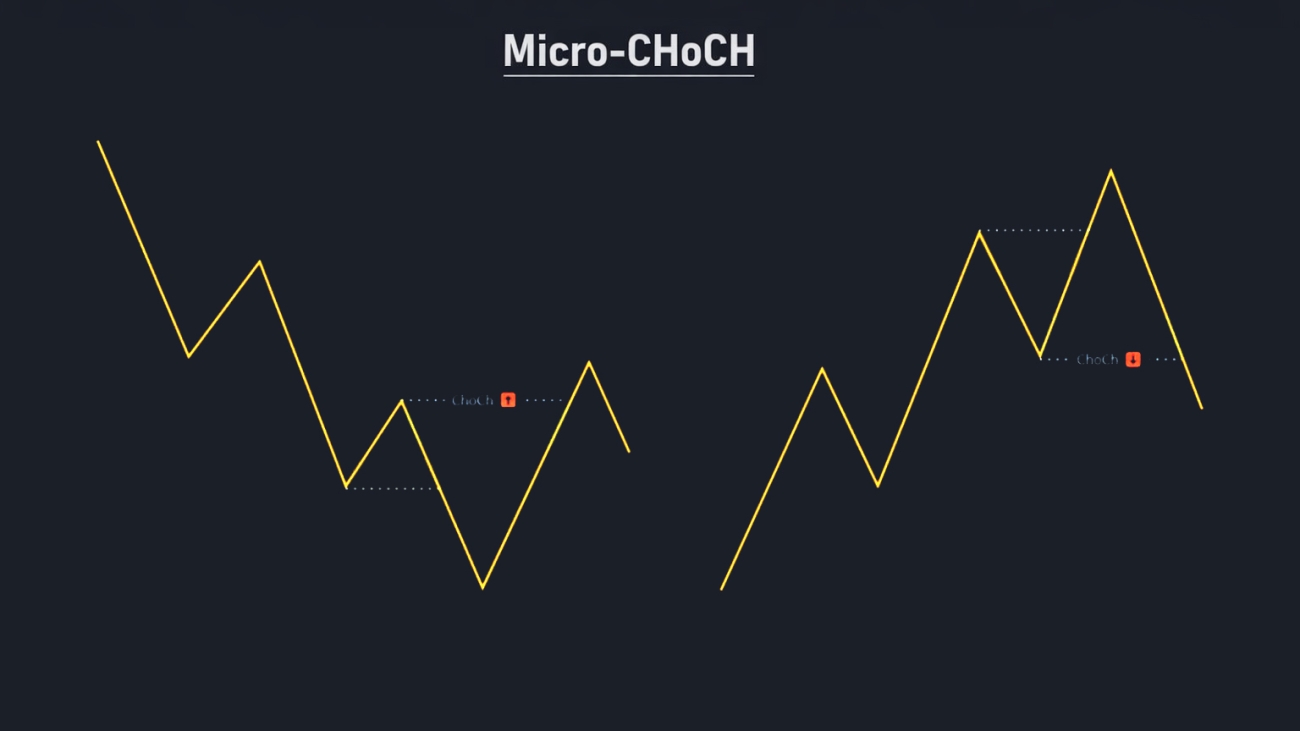
Micro-CHoCH-02

A practical two-timeframe Order Block strategy workflow

It’s London morning in Muscat. My work window starts at the beginning of the London session and ends near the end of the New York session. I open my charts and the first thing I do is check EURUSD H1 ATR. If it’s normal, I stick to my normal preset: H1 for structure and M5 for entries. I don’t want a strategy that changes every five minutes, but I also don’t want to ignore volatility and high-impact news. So I use a simple structure: two timeframes for trading (structure + trigger), and one extra timeframe only for volatility regime. I then check the economic calendar for anything high-impact. If there’s a major release, I plan to be flat around it.

I mark one clean H1 bullish order block that caused a strong displacement and took a prior swing high. Price later retraces into that zone. I don’t buy just because it touched. I drop to M5 and wait for a micro-CHoCH: price stops making lower highs and closes above the nearest opposing swing high. That close is my confirmation that reaction is likely in motion. Then I enter with a stop beyond the invalidation and I target the nearest liquidity first. When the market is fast, I take profit sooner; when the market is calm, I can aim for a cleaner 2R.

The core idea in one sentence

I use a Higher Timeframe (HTF) Order Block to define where I want to trade, a Lower Timeframe (LTF) micro-structure shift (CHoCH) to define when I’m allowed to enter, and I use H1 ATR as a quick volatility regime filter to choose the right two-timeframe combo for the day.

Definitions

TermMeaning (simple)
Order Block (OB)A candle or small group of candles that preceded a strong move. In OB trading, it marks a zone where large orders likely existed.
HTF / LTFHigher Timeframe (structure) and Lower Timeframe (entry/trigger). Example: H1 for structure and M5 for entry.
RetracePrice returns back into a previously marked zone after moving away.
Touch vs Close-in-zoneTouch: any wick/body enters the zone. Close-in-zone: the candle must close inside the zone (stricter).
Internal market structureLocal swing highs/lows on the entry timeframe that form the short-term trend.
Swing high / Swing lowA local peak or trough. For example, a swing high is higher than the highs of a few bars around it.
CHoCH (Change of Character)A small structure shift: the market stops making lower highs and breaks a key swing high (or vice versa).
BOS (Break of Structure)A structure break that continues the prevailing direction (often HTF).
DisplacementA fast, impulsive move away from an area (often measured with ATR or a strong candle body).
Liquidity sweepPrice briefly takes a prior high/low (stops) and then reverses.
ATRAverage True Range: a volatility measure. Higher ATR means larger typical movement.
R multipleRisk unit: if your stop is 10 pips, then 2R take-profit is 20 pips.

My best trading windows in Muscat time

I prefer to trade when liquidity is naturally high. For EURUSD, the best consistency usually happens around London open and during the London–New York overlap.

  • London open focus: 12:00–15:00
  • London–New York overlap (often best): 18:00–21:00
  • Late New York (optional, lower quality): 21:00–00:30

Note: Exact session clocks shift when London/NY change daylight saving time. I keep the idea the same (trade the open and the overlap), and I adjust the clock times on my calendar when DST changes.

The third timeframe: volatility regime check (H1 ATR)

For EURUSD, I prefer EURUSD-based volatility measures over VIX. VIX is equity volatility; it can help as a risk mood hint, but it isn’t the same as FX volatility. So my daily volatility check is H1 ATR(14) on EURUSD. H1 is fast enough to capture today’s conditions, but stable enough to avoid M1/M5 noise.

My simple regime rule

  1. Compute H1 ATR(14) and compare it to a rolling average (e.g., a 20-day average of H1 ATR).
  2. If today’s H1 ATR is around normal: trade the normal preset.
  3. If H1 ATR is clearly elevated: use a slower trigger timeframe and stronger HTF zones (reduce noise).
  4. If H1 ATR is very low: expect range behavior and be selective (or use a higher trigger TF to avoid overtrading).

Best-practice two-timeframe presets for day traders

Instead of switching timeframes randomly, I keep 2–3 preset combinations. This gives me a consistent process while still adapting to volatility and news days.

RegimeStructure TF (OB)Trigger TF (Entry)Why this works
Normal dayH1M5Clean enough zones + precise entries; good trade frequency for a day trader.
High volatility / messy dayH4M15Stronger zones + fewer whipsaws; reduces fake-outs when candles are violent.
Low volatility / range dayH1M15Fewer signals and less noise; avoids overtrading in tight ranges.

High-impact news: what I do (and what I avoid)

On days with major releases (CPI, NFP, FOMC, ECB decisions, etc.), the worst habit is forcing entries during the release spike. OB zones can be pierced by wicks and spreads can widen. My rule is simple: I either stand aside around the event or I only trade after the market rebuilds clean LTF structure.

  • No new positions shortly before the release.
  • No trades during the immediate spike.
  • After the release: wait 15–60 minutes and require a clean LTF structure + micro-CHoCH inside/near the zone.
  • If the day is pure chaos (wide spikes both ways): I switch to the high-vol preset or I stop trading.

How I identify a high-probability HTF Order Block using my own indicator

I don’t draw OBs everywhere. I only care about OBs that look causal.

  • The OB should precede displacement (a strong impulsive move away).
  • Prefer OBs that also break structure (BOS/CHOCH) on the HTF.
  • Freshness matters: first touch is best; I usually ignore second/third touches unless I have strong confluence.
  • I define the zone consistently: wick-based (high/low) or body-based (open/close).

Definition 1: What counts as a retrace into the OB zone?

For beginners, this is where confusion starts. So I define it explicitly and keep it consistent.

Two valid definitions (choose one):

  • Touch rule (common for day trading): Price has entered the zone if any LTF candle’s high/low overlaps the zone. This captures wick touches and helps me not miss reactions.
  • Close-in-zone rule (stricter, fewer trades): Price has entered the zone only if an LTF candle closes inside the zone. This reduces false drive-by touches but can miss quick bounces.

My best-practice approach: I use the touch rule to arm the setup, but I still require LTF structure confirmation (micro-CHoCH) before I enter.

Definition 2: What is internal market structure on the LTF?

Internal market structure is simply the local swing highs and swing lows on the entry timeframe. I need it because CHoCH must break something real, not random noise.

Beginner rule: On M5, I treat a swing high as a candle whose high is higher than the highs of the 2 candles on each side (and similarly for swing lows). On M1, I may use 2–3 candles on each side to reduce noise.

Definition 3: What is the break of the immediate opposing swing?

This is the micro-CHoCH trigger in one line: after price enters the zone, I wait for a candle close that breaks the nearest opposing swing point on the LTF.

  • For a LONG inside a bullish/demand OB: Mark the most recent LTF swing high formed during the push down into the zone (the last lower-high). A valid micro-CHoCH is an LTF candle close above that swing high.
  • For a SHORT inside a bearish/supply OB: Mark the most recent LTF swing low formed during the push up into the zone (the last higher-low). A valid micro-CHoCH is an LTF candle close below that swing low.

Best practice: use close-based breaks (not wick-only) to reduce fake-outs.

My step-by-step entry workflow (the checklist I follow)

  1. Volatility check (H1 ATR): decide whether today is normal, high-vol, or low-vol.
  2. Select the preset combo (example: normal = H1 + M5).
  3. Mark the HTF OB that caused displacement and ideally broke structure.
  4. Wait for price to retrace into the OB zone (touch arms the setup).
  5. On LTF, wait for a micro-CHoCH (close-based break of the immediate opposing swing).
  6. Enter on the break close (aggressive) or on the retest/mitigation (conservative).
  7. Stop-loss goes beyond invalidation (OB edge or the LTF swing that formed the CHoCH) plus a small buffer.
  8. Targets go to the nearest liquidity / opposing swing; consider partial take-profit and a runner.

Risk management: why this matters more than the entry

Order blocks are zones, not magic lines. My edge comes from selecting good zones, confirming reaction, and managing risk. If I lose control of risk on high-vol news days, no entry model will save me.

  • I risk a fixed percentage per trade (not a fixed lot size).
  • I avoid trading when spreads are abnormal or fills are poor.
  • If the OB is too large for my stop tolerance, I either refine on LTF or I skip the trade.
  • I stop after a predefined number of losses for the session (to avoid revenge trading).

Dynamic vs static: should I change timeframes every day?

I don’t believe in random switching. I believe in controlled adaptation. A completely static strategy ignores volatility and news regimes; a completely dynamic one turns into guessing. The best practice is to keep a small menu of presets and switch using objective rules (like H1 ATR regime and a known high-impact news schedule).

  • Keep 2–3 presets only (for example: H1+M5, H4+M15, H1+M15).
  • Use one volatility check (H1 ATR) and one news check (economic calendar) to pick the preset.
  • Don’t redesign rules mid-session. If you change, change only at planned checkpoints (before London, before NY).

Common mistakes (and how I avoid them)

  • Drawing too many order blocks and treating all of them as equal.
  • Entering on the first touch without any LTF reaction confirmation.
  • Using M1 triggers on high-vol days and getting chopped.
  • Trading major news spikes with normal-day rules.
  • Using a fixed lot size instead of fixed risk per trade.

FAQ

What is the best timeframe combination for day trading EURUSD with order blocks?

A common best-practice combo is H1 for the order block and M5 for the entry trigger. On high-volatility or news days, many day traders switch to H4 for structure and M15 for entries to reduce whipsaws.

Is VIX a good volatility indicator for EURUSD day trading?

VIX can hint at risk-on/risk-off mood, but it measures US equity volatility. For EURUSD, EURUSD’s own ATR (such as H1 ATR) is usually a more direct volatility check.

What does it mean when price retraces into an order block?

It means price returns into the order block zone after moving away. You can define entry as a touch (wick/body overlap) or a close inside the zone (stricter).

What is a micro-CHoCH on the lower timeframe?

Micro-CHoCH is a small structure shift on the entry timeframe: after price enters the zone, the market closes beyond the nearest opposing swing point, signaling momentum may have flipped.

Should I change my timeframes every day?

It is better to keep a small set of preset timeframe combinations and switch only when objective conditions change (volatility regime and high-impact news). Random switching usually reduces consistency.

Final note

This workflow is designed to be practical: clear zones, clear confirmation, and controlled adaptation. Implement it consistently first, track results by session (London, overlap, late NY), and refine only one variable at a time.

My Order Blok Indicator for TradingView

Here is my OB Indicator that I use in TradingView. You can change the settings in its setting panel as you need. Feel free to report any problems or suggestions you’ve had with it.

Multi Timeframe Order Block v1.4.1

Machine Thinking

Machine Thinking

Machine Thinking is the set of methodologies and culture used by humans to teach machines how to advance towards a design goal.

Traditionally in modern product development you’ll likely find a core team of a Product Manager, Product Designer, and Application or Product Engineer. In an A.I. First model we need to add a Machine Learning Engineer and a Machine Learning Researcher.

Unlike traditional product development process, the team’s job will center less around what humans (or users) need and instead focus on the creation of algorithms and pathways for a machine to learn and output based on that learning.

In Machine Thinking, we are designing a set of interaction models for a machine to learn, output, and interact with a human (or other machines) with potentially infinite variations and outcomes.

As designers we naturally labor over the finest details of our work. But in an A.I. First model, we will not know many of the details. Machine Thinking places the emphasis less on the perfection of the design output, and more on the robustness of the design system.

I’ve encouraged teams to spend more of their cycles creating strong system maps, agnostic of interfaces, that outline the interaction model. In Machine Thinking this becomes even more valuable.

A simple Machine Thinking exercise: what are the fewest number of components (interaction or interface) that are capable of solving the greatest number of known transactions?

Web3 apps replace Web2 apps

Web3 apps replace Web2 apps

Web3 is the new version of the World Wide Web that incorporates concepts such as decentralization, blockchain technology , and token-based economy (Tokenomics). However, Web 2.0 (the same content and applications and websites that we have been using since 2000) has data and contents that are centralized in a small group of companies that are sometimes called “Big Tech”.

In the last few years, the Web3.0 movement aims to eliminate these big and monopolistic middlemen by granting the full ownership of the contents to the users and creators and helping them generate revenue from. I will introduce some alternatives to web2 apps, services and websites below:

Operating System

web2:

Microsoft Windows

Apple iOS

Google Android

Web3:

Ethereum

Solana

Aptos

Polkadot

Music

web2:

Spotify

Web 3:

Audio

Search

web2:

Google Google

Web 3:

Presearch

Messenger

web2:

WhatsApp

Web 3:

Status

Payment

web2:

PayPal

Web 3:

Metamask

Transportation

web2:

Uber

Web 3:

DIMO

Video and online streaming

web2:

YouTube

Web 3:

Livepeer

Online map and navigation

web2:

Google Maps

Web 3:

Hivemapper

Web browser

web2:

Google Chrome

Web 3:

Brave

Business network and job search

web2:

LinkedIn

Web 3:

BrainTrust

The variety of blockchain projects is not limited to Web3. Below you can check some decentralized projects and their cryptocurrencies :

Diversity of decentralized areas in the world of cryptocurrencies

04

Maximal Extractable Value – MEV

Modern markets require intermediaries (brokers or brokerages) to aggregate and execute transactions on behalf of market participants. While blockchains decentralize the security and ownership of these intermediaries, networks still require them to execute transactions. Consequently, a blockchain’s intermediaries, in the form of security providers (miners, validators, and sequencers), become first-class citizens of the network in the same way that brokers do in traditional markets.

Such a power dynamic allows a blockchain’s security providers to tax users and generate additional profits during the block production process. They do so by selectively inserting, reordering, or censoring user transaction requests. This invisible, yet ubiquitous, phenomenon is what is known as Maximal (formerly Miner) Extractable Value (MEV).

Effects of MEV

MEV creates both positive and negative externalities for blockchain networks. It creates efficient markets and incentivizes proper application functionality within distributed crypto economies. However, if left uncontrolled, MEV may jeopardize network decentralization and consensus stability. Accordingly, the crypto industry is beginning to recognize the significance of MEV both as a for-profit opportunity and as an existential threat.

MEV’s emergent and abstract nature makes it difficult to define concretely. To address its intricacies, this report will provide an in-depth look at the origins of MEV before evaluating its role in the present and future state of blockchain networks.

The good

Many DeFi projects rely on economically rational actors to ensure the usefulness and stability of their protocols. For instance, DEX arbitrage ensures that users get the best, most correct prices for their tokens, and lending protocols rely on speedy liquidations when borrowers fall below collateralization ratios to ensure lenders get paid back.

Without rational searchers seeking and fixing economic inefficiencies and taking advantage of protocols’ economic incentives, DeFi protocols and dapps in general may not be as robust as they are today.

The bad

At the application layer, some forms of MEV, like sandwich trading, result in an unequivocally worse experience for users. Users who are sandwiched face increased slippage and worse execution on their trades.

At the network layer, generalized frontrunners and the gas-price auctions they often engage in (when two or more frontrunners compete for their transaction to be included in the next block by progressively raising their own transactions’ gas price) result in network congestion and high gas prices for everyone else trying to run regular transactions.

Beyond what’s happening within blocks, MEV can have deleterious effects between blocks. If the MEV available in a block significantly exceeds the standard block reward, validators may be incentivized to reorg blocks and capture the MEV for themselves, causing blockchain re-organization and consensus instability.

This possibility of blockchain re-organization has been previously explored on the Bitcoin blockchain. As Bitcoin’s block reward halves and transaction fees make up a greater and greater portion of the block reward, situations arise where it becomes economically rational for miners to give up the next block’s reward and instead remine past blocks with higher fees. With the growth of MEV, the same sort of situation could occur in Ethereum, threatening the integrity of the blockchain.

The MEV Supply Chain and Transaction Lifecycle

The pending transaction pool on a blockchain is a dark forest ripe for profit exploitation. Luckily, there are a few tools that can be used to shed light on MEV’s mysteries. The MEV supply chain is a framework recently introduced by the research organization, Flashbots. It describes the chain of actors that influence a transaction in the presence of MEV. These general classifications hold true across different blockchain networks but may serve slightly different roles depending on a network’s design choices.

Roles Within the MEV Supply Chain

02

The cold fall of Bitcoin miners

During the 2021 bull market, many mining companies took advantage of rising bitcoin prices by raising capital through the issuance of new equity and debt in order to grow their operations. Public mining stocks exploded upwards alongside Bitcoin. However, the broader macro environment caused the euphoria to come to an abrupt halt in 2022. Hashrate at an all-time high combined with increasing energy prices and bitcoin trading near its cycle low have put miners in an increasingly difficult position. Many public miners have resorted to selling bitcoin to continue financing their operations and to service their debts.

What’s different this cycle compared to last cycle is the increased participation of public companies in the mining industry. The Hashrate Index reported that in October 2021, public miners represented 11% of the total hashrate. One year later, public miners’ share of the total hashrate has increased to 33%. In the event that some of these companies end up going bankrupt due to being mismanaged, they will have to sell the bitcoin on their balance sheet, adding downward pressure to the trading price.

Crypto-Tokens-and-Crypto-Coins-What-Drives-Performance

Is crypto market decoupling from equities?

Bitcoin and Ethereum’s 30-day realized volatility has been falling sharply during a period in time where the S&P 500’s realized volatility is trending upwards. The increased volatility in equities is likely attributed to high-interest rates, an appreciating dollar, and companies reporting poor quarterly earnings. The divergence in volatility could signal a potential decoupling between crypto and equities. Since peaking in early July, Bitcoin and Ethereum’s realized volatility has declined 67% and 63%, respectively.

On the other hand, crypto finally broke out from its low volatility, with strong rallies across the market. As we’ll discuss, this contrasts the crash several tech stocks experienced following the release of their Q3 earnings reports.

Does this mean crypto is no longer correlated to stocks? This week we dive into data to answer this question, while also looking at on-chain data for Ethereum, potentially explaining its strong price performance.

This Week’s Key Metrics

[one_half]

Bitcoin BTC
Price
$20,250 (+6.3%)

Total Fees 

$1.84M (+2.2%)

Exchange Flows

-$1.27B (-$1.1B)

[/one_half][one_half_last]

Ethereum ETH
Price
$1,500 (+17.2%)

Total Fees

$26.2M (+11.0%)

Exchange Flows

-$65M (-$13M)

[/one_half_last]


Fees – Sum of total fees spent to use a particular blockchain. This tracks the willingness to spend and demand to use Bitcoin or Ether.

  • Bitcoin and Ethereum fees climbed as price action broke out to the upside
  • In BTC and ETH terms, though, fees were lower than last week

Exchanges Netflows  – The net amount of inflows minus outflows of a specific crypto-asset going in/out of centralized exchanges. Crypto going into exchanges may signal selling pressure, while withdrawals potentially point to accumulation.

  • Bitcoin recorded its largest daily net outflow from centralized exchanges on Wednesday when over $1.5B was withdrawn

Ether saw modest outflows regardless of the strong price action

Crypto Outperforming Stocks

Bitcoin and Ether have performed better than stock indices over the past three months

  • Despite rate hikes and geopolitical uncertainty, Bitcoin and Ether have held up better than the Nasdaq100
  • Year-to-date, BTC’s -56% and ETH’s -59% are significantly better than the performance of tech stocks such as Meta’s -71% or Snap’s -80%

The strong performance as of late has resurfaced questions about crypto’s correlation to stocks.

Rebound From Yearly Lows

The correlation between Bitcoin and stock indices reached its lowest level in 2022 in mid October but has since climbed

  • As earnings season began in mid October, the trend between stocks and crypto became stronger
  • Correlation coefficient had reached a level of 0 for the first time since the first week of January prior to earnings, suggesting no statistical relationship between the two values

Economic results and projections from large companies had a toll on crypto’s performance, though perhaps not as much as some would have expected.

Stocks Crash, Crypto Climbs

Crypto kicked off the week with a strong rally and remains higher despite subpar big tech earnings

  • Bitcoin and Ether’s sharpe ratio over the past 30 and 90 days is higher than the tech ETF QQQ, suggesting crypto has been a better risk-adjusted return as per ITB data
  • Intra-day, however, Google and Amazon’s negative results dragged down Bitcoin a few percentage as shown by the first and third vertical lines in the chart above
  • Meta’s results leading to a 25% decline in the stock seemed to have little impact on Bitcoin and Ether

Here ETH in particular has been leading crypto’s outperformance.

Ethereum Fees Spike

Increased network demand could be behind ETH’s outstanding 17% price increase

  • Higher Ethereum fees means more ETH is spent to use the network
  • Moreover, high demand for Ethereum also leads to decreasing ETH supply, as ETH becomes deflationary when fees are above 17 gwei (orange line above)

ETH’s supply increase since the merge has been of only 1.1k ETH, compared to the 509k ETH inflation that would have happened under the proof of work network, translating to an effective 99.78% decrease in net issuance

Screen_Shot_2022-04-04_at_9.42.42_PM

Proof of Physical Work

One of the most powerful features of crypto-economic protocols is their ability to create incentive structures that allow anyone in the world to permissionlessly contribute to a set of shared objectives. These incentive structures can be finely tuned to facilitate large-scale coordination to achieve specific goals.

This represents a step-function improvement in capital formation.

The vast majority of crypto-innovation to date has been focused on coordinating digital communities and economies; however, tokens also create opportunities for innovation in capital formation and human coordination that extend beyond the digital world and into the physical.

We refer to this thesis as “proof of physical work.” Protocols that fit this thesis incentivize people to do verifiable work that builds real-world infrastructure. Relative to traditional forms of capital formation for building physical infrastructure, these permissionless and credibly-neutral protocols:

  1. Can build infrastructure faster—in many cases 10-100x faster
  2. Are more attuned to hyper-local market needs
  3. Can be far more cost effective

Our first investment within this thesis was Helium. Helium is a crypto-economic protocol which incentivizes people to build and manage physical telecommunications networks—e.g., micro-cell towers. The Helium Network is built by “hosts” who mine HNT, the native token of the Helium protocol, in exchange for creating coverage and transferring data over the network. The Helium network launched in August 2019 and in the two and a half years since it has grown to over 600,000 hotspots that are currently providing connectivity and coverage all over the world.

For context, the entire U.S. telecommunications industry has 417,000 cell towers, and estimates for the total number of cell towers in the world range from 3M to 8M. The Helium Network has achieved a similar level of scale in just 30 months because it created powerful incentives that encouraged people around the world to build the network. While centralized corporations build their networks in a top-down and rigid process, decentralized crypto-economic protocols are able to grow faster in a bottom-up way everywhere at once.

Helium Hotspots are not the same size or power of corporate cell towers because they don’t need to be. The Helium Network makes up for this by having many more hotspots, all deployed at a tiny fraction of the cost of their corporate competitors. Permissionless, crypto-economic protocols rely on redundancy to offer network-level reliability even when individual network nodes are not as reliable. Whereas building new towers incurs incremental labor costs for traditional telecoms networks, labor cost in the Helium network is $0. This is an asymmetric advantage that enables Helium to compete on a vector that traditional telecoms cannot: the Helium network consists of a higher density of smaller antennas.

We recently announced our investment in Hivemapper, another protocol that traverses digital-to-physical realms using crypto-incentives. Hivemapper is a decentralized map built by people using dashcams—and it represents a fundamental shift in how maps are built.

Every photo in street view in Google and Apple Maps was taken by a Google or Apple employee in a specialized car with a 3D camera. Those cars are driven for more than 12 hours per day, and yet Google and Apple’s maps are in many cases years out of date. The cost of these cars and drivers is simply too high for Apple and Google to justify adding more of these resources. Therefore, there is no such thing as a real-time map, or anything approaching it.

Hivemapper creates a new way to update maps with much higher frequency and at much lower cost by outsourcing the mapping to individuals who already own “good enough” hardware. Hundreds of millions of people drive everyday. Imagine if just 1% of those people mapped the roads around them while they drove. The maps would include every new highway off ramp, small business, neighborhood street, pothole, etc. within a matter of hours or days. This is only possible because of HONEY, the native token of Hivemapper, which rewards mappers for continuously contributing fresh, updated information to its map.

Hivemapper is not just limited to street maps, though that is where it is starting. The same network can collect and map other types of data like air pollution, wireless coverage quality, noise, weather, and more. It’s clear how Hivemapper is able to create maps at a lower cost than Apple and Google. With this in mind, the proof-of-physical-work naturally extends to other use cases as well.

Helium and Hivemapper are only two examples of protocols using crypto-incentives to bridge the physical and digital worlds. At Multicoin Capital, we’re fascinated by this space and think the design space is vast. We also think it presents one of the best opportunities to disrupt capex-intensive business models with a novel form of capital formation.

Some may argue that such models of coordination are replicable without crypto— stock agreements and bonus rewards for aligned actors are already present in most centralized organizations. However, crypto-economic protocols unlock five key benefits:

  1. Rapid Scale — Permissionless and borderless protocols can grow everywhere in the world in parallel across many legal jurisdictions.
  2. Credible Neutrality — Credibly-neutral networks give their stakeholders guarantees that the rules can’t arbitrarily be changed from underneath them.
  3. Collective Ownership — A system that is owned by its users creates loyalty, aligns incentives, and drives growth.
  4. Frictionless Payments — Blockchains allow for peer-to-peer micropayments that the legacy payments system cannot support.
  5. Integration with DeFi rails — DeFi rails are useful for bootstrapping liquidity via automated market makers. Overtime, we also expect proof-of-physical-work networks to leverage other composable DeFi-native tools, including NFT marketplaces, social tokens, derivatives, and more.

Given society’s collective experience with centralized capital formation over hundreds of years, the natural inclination is to think about solving this class of problem in a centralized fashion, in which a single company decides who, when, where, and how people are compensated. We contend that this model is obsolete in the internet era. A corporation making central planning decisions and compensating its stakeholders at its discretion will never be as effective as a properly designed permissionless network that scales and compensates its most productive actors using the free market’s conceptions of supply and demand.

Small individual operators have never been able to compete with large corporations on large-scale infrastructure (e.g., telecommunications, mapping, electric grids, third party logistics, etc.), until now. Proof of physical work represents a paradigm shift in how businesses operate and scale. Crypto-economic protocols allow for people to coordinate their economic activities without a centralized, rent-extracting party, and will help move these industries from corporate feudalism to meritocratic capitalism and freer markets.

Disclosures: Multicoin has established, maintains and enforces written policies and procedures reasonably designed to identify and effectively manage conflicts of interest related to its investment activities. For more important disclosures, please see the Disclosures and Terms of Use available here.

Renewable-energy-5-1392x810_800_466_85

DeWi – The Decentralized Wireless Movement

Key Insights

  • Decentralized Wireless (DeWi) aims to revolutionize the way communication networks are built, operated, and owned by incentivizing operators to deploy and maintain telecom hardware in exchange for token rewards.
  • DeWi networks achieve superior unit economics compared to legacy providers due to the reduction in CapEx and OpEx; DeWi also eliminates spectrum licensing costs and flat rate charges to end users.
  • As of October 2022, there are more than 14 DeWi networks (including cellular, WiFi, IoT, Bluetooth, and hybrid networks) supported by an ecosystem of enterprise deployers, service providers, and marketplaces.
  • Among the most immediate opportunities for DeWi is the 5G cellular market, with Helium and Pollen Mobile leading the charge.

Technological advances in hardware and telecom infrastructure over the past few decades have created a hyperconnected world, where 2.5 quintillion bytes of data are created every day. Thanks to mobile phones, today, 66% of the world uses the internet as opposed to 7% in 2000. As internet connectivity and access around the world increase, the amount of data created will only continue to increase.

The rise of new technologies – autonomous vehicles, the Internet-of-Things (devices with sensors connected to the internet), smart cities, and extended-reality environments –  has led to an increase in global demand for higher bandwidth and lower latency networks. However, traditional wireless (TradWi) network operators are unable to keep up with this increased demand.

A new generation of telecom cowboys is pioneering the decentralized wireless (DeWi) movement. These cowboys offer an alternative method to deploying and operating networks using cryptoeconomic protocols. Next-generation wireless networks can be bootstrapped using the coordinating abilities of blockchain technology. Instead of a single, centralized telecom player building out a wireless network, millions of sovereign individuals can be aligned to deploy and operate wireless infrastructure in a trustless, permissionless, and programmatic manner.

Background on the Telecom Industry

Deploying wireless networks has historically required the work of large corporations due to considerable capital expenditures (CapEx) and operational expenses (OpEx), complicated logistics, and regulatory hurdles. This resulted in a handful of companies controlling the pricing structure and conditions for the end user, effectively eliminating a free market. In the US, just three companies – AT&T, Verizon, and T-Mobile – make up 98.9% of the wireless market. In Q2’22, these companies cumulatively generated $270 billion of annualized revenue.

Traditionally, roughly every 10 years, telecom companies (telcos) deploy new wireless networks. This process involves:

  • Raising tens of billions of dollars in debt to finance CapEx and OpEx
  • Buying spectrum licenses from the government
  • Contracting manufacturers to build proprietary hardware
  • Finding property owners willing to host towers and radios
  • Mobilizing thousands of field technicians to install and maintain complex equipment

Disrupting a Sleepy Trillion-Dollar Industry

Today’s digital age has resulted in a $1.7 trillion global telecom market that is expected to grow at a 5.4% compound annual growth rate (CAGR). By 2028, the global telecom market is expected to reach $2.7 trillion. However, the lack of competition, enormous customer dissatisfaction, and the constant demand for higher bandwidth connectivity at increased speeds has set the industry up for disruption.

The traditional top-down model telcos use to build networks is unsuitable for building next-generation wireless networks. New wireless networks –  such as 5G – require significantly more radios and antennas than older generation networks, which is not economically feasible for telcos. Additionally, the legacy telco model has traditionally been optimized to cover densely populated areas, leaving many less populated, rural areas without adequate coverage. If one lives in a region without proper coverage, there isn’t much that can be done if relying on TradWi telcos.

With DeWi’s open access deployment model, DeWi networks can add wireless density where it’s not financially feasible for TradWi providers. DeWi also empowers individuals to improve their connectivity. For example, the owner of a restaurant with historically bad connectivity could deploy their own DeWi equipment, solving their connectivity problem for themselves and their customers. While it’s highly unlikely that DeWi completely replaces TradWi networks, the two can coexist with one another and have a symbiotic relationship.

Why DeWi Now?

During the past few years, the telco industry has undergone three major shifts that have positioned DeWi adoption to happen now: eSIMs going mainstream, the opening of wireless spectrums, and the advancement of blockchain technology and wireless hardware.

eSIM Going Mainstream

Last month, Apple released the iPhone 14 with one major difference: there is no longer a physical SIM card slot. The latest iPhone embraces the digital alternative known as an eSIM, which can be configured by scanning a QR code. This is a significant development for DeWi cellular networks because it reduces carrier switching costs to near-zero. Additionally, since the iPhone 14 has 6 eSIM slots, users can install a DeWi eSIM in addition to their existing traditional carrier’s eSIM, and utilize both cellular networks.

In 2021, it was estimated that 350 million eSIM-capable devices were shipped globally. By the end of this decade, it is projected that there will be around 14 billion eSIM-capable devices. Apple’s recent decision to go the eSIM route will likely accelerate this trend.

Opening of Wireless Spectrums

Spectrum refers to the radio frequencies that wireless signals travel over. In the U.S., spectrum is overseen by the Federal Communications Commission (FCC) and is categorized into two types: licensed and unlicensed.

Licensed spectrum is auctioned off by the FCC to the highest bidder, meaning it’s bought for exclusive use by specific network operators. Over the lifetime of these auctions, $250+ billion has been paid to the U.S. Treasury from spectrum license sales. This is an expense that telcos have passed down to consumers.

Unlicensed spectrums on the other hand are available for anyone to use. WiFi, Bluetooth, and LoRaWAN are unlicensed spectrums.

The Citizens Broadband Radio Service (CBRS) band was previously only available for use by the U.S. Navy.  However, in 2020, the FCC authorized public use of the CBRS band. This is significant because it allows new entrants to deploy 5G networks without having to acquire expensive spectrum licenses.

Back in 1985, the FCC fundamentally changed the way humans communicate and operate by opening up the WiFi spectrum band for public use. It allowed anyone to buy a WiFi router and create their own wireless connection. It’s possible that CBRS can revolutionize cellular networks in the same way that WiFi did for internet connectivity.

Advancement in Blockchain Technology and Hardware

Humans are incentive-driven. However, before blockchains, it was extremely difficult to facilitate large-scale coordination of individuals globally. Now, with cryptoeconomic protocols, individuals can be incentivized to work toward a common goal in a trustless and programmatic way.

Additionally, advancements in wireless technology have made hardware more affordable and accessible. Plug-and-play hardware makes it easy for the average person to participate in deploying DeWi hardware.

The DeWi Movement

A new era of innovation has emerged that leverages token incentives for the development of physical infrastructure networks in the real world. This category has been referred to as Proof of Physical Work (PoPW), Token Incentivized Physical Infrastructure Networks (TIPIN), or EdgeFi.

Escape Velocity, a fund focused on investing in decentralized infrastructure networks, has broken down the physical infrastructure space into the following sectors: decentralized wireless (DeWi) networks, sensor networks, server networks, and energy networks. Despite the potential of these networks, the DeWi sector has attracted the earliest attention.

DeWi aims to revolutionize the way communication networks are built, operated, and owned by incentivizing operators to deploy and maintain telecom hardware in exchange for token rewards. By distributing the costs associated with building and maintaining a network to supply-side participants, a more cost-effective method of bootstrapping a network is uncovered.

DeWi’s Origin Story

In July 2019, Helium pioneered the DeWi movement with its LoRaWAN network designed to power the Internet of Things (IoT). Through the success of its LoRaWAN network, which has grown from 15,000 hotspots in January 2021 to over 900,000 hotspots today, Helium has shown that token incentives can be used to build out distributed infrastructure networks. Helium’s LoRaWAN network stands as the largest IoT network in the world, operating in over 182 countries.

More recently, Nova Labs – the company behind Helium – announced its vision to transform Helium into a decentralized platform where any type of telecom network can be deployed. This strategic shift turned Helium into a network of networks, where the same process that enabled the LoRaWAN network to rapidly scale could be replicated onto numerous other network types including 5G, WiFi, VPN, and CDN.

The DeWi Sector

With the success of Helium’s LoRaWAN network, many projects were inspired to launch new DeWi networks using a similar model to Helium’s. Today, more than 14 DeWi networks exist, including cellular, WiFi, LoRaWAN, Bluetooth, and hybrid networks.

  • 5G Networks (Cellular): The two prominent players in this category are the Helium 5G and Pollen Mobile networks that leverage the recently deregulated CBRS spectrum. The cellular market opportunity is the largest compared to other network market sizes.
  • WiFi Networks: DeWi WiFi networks aim to create a globally shared WiFi network that anyone can connect to at a low cost. WayRu and WiFi Dabba are two early-stage projects building in this category.
  • LoRaWAN Networks (IoT): LoRaWAN (Long Range Wide Area Network) is a long-range and low-power wireless communication protocol. It is suitable for transmitting small data packets – like sensor data – over long distances, which has made it the go-to network for IoT devices. Besides Helium, Foam and Mesh+ are building in this category.
  • Bluetooth Networks: Bluetooth Low Energy powered networks are suitable for low-power and low-range use cases. Nodle is a Bluetooth mesh network that leverages smartphones and Bluetooth Low Energy routers to connect IoT devices to the internet.
  • Hybrid Networks: Hybrid networks combine different wireless technologies into a single solution to provide decentralized internet connectivity. Althea and World Mobile Token are two examples of this.

How the Model Works

DeWi networks utilize a novel token distribution mechanism that rewards participants for completing verifiable work in the real world. This incentive system is responsible for the economic flywheel that allows a network to be bootstrapped without a centralized entity.

The economic flywheel begins by offering users a reward to acquire and deploy network hardware:

  1. Hardware operators are incentivized with inflationary token rewards for purchasing and deploying a hotspot or radio and maintaining it. These rewards act as a subsidy for operators, allowing them to immediately begin earning a return on their hardware investment. The rewards typically support the participants in building the network before the network begins generating sustainable fees from demand-side usage.
  2. As the wireless network grows, more operators and product builders are attracted to the network. Additionally, DeWi’s improved unit economics (compared to TradWi) and the token subsidy to hardware operators allow the protocol to offer cheaper data transfer rates, helping attract end users.
  3. Once the network’s coverage grows large enough to warrant end users to begin paying to transmit data through the network, revenue for hardware operators increases significantly. In addition to the network’s subsidy, operators earn fees based on the amount of data flowing through their hardware. This economic mechanism creates a feedback loop that ends up attracting more hardware operators and investors.
  4. Value is typically captured through a burn-and-mint equilibrium (BME) token model or a work-token model. While a network’s utility increases as supply is either burned via a BME model or staked by service providers via a work-token model, the token price should theoretically increase. The rising token price flows back into attracting more hardware operators, creating a ۀcycle.

The network effect created by the DeWi economic flywheel essentially solves the cold start problem. Using rewards, a protocol can motivate participants to bootstrap the supply-side of a network to the point where its coverage is large enough for end-user use. This allows protocols to build up the initial momentum needed to gain adoption and compete with centralized telcos. In exchange for building out the supply side of a network, operators receive ownership stakes in the network, which motivates them to see it succeed.

Legacy Network Deployment Model vs. DeWi’s Model

The DeWi method of deploying networks improves significantly upon the legacy model. The above chart builds ontop of Borderless Capital’s EdgFi research.

The largest advantage DeWi has over TradWi’s network deployment is the reduction in CapEx and OpEx. Building networks the legacy way requires a centralized entity to spend tens of billions of dollars to acquire spectrum licenses, purchase proprietary hardware with vendor lock-in, lease land for deployments, pay thousands of field technicians to install and maintain equipment, and maintain a massive back-end infrastructure for planning, onboarding, billing, and customer support. And the costs are ultimately passed onto the consumer.

Using the DeWi method, CapEx and OpEx are crowdsourced to individual operators participating in the network. Operators purchase commoditized, off-the-shelf hardware that can be installed with little effort. For example, setting up a LoRaWAN hotspot is as easy as plugging ethernet and power cables into the device, which takes less than five minutes. On the other hand, cellular radios are a bit more complex for the average person, requiring additional time and technical knowledge to install.

For retail deployments, DeWi operators are able to place their hardware on properties they own, removing any real estate costs. For commercial deployments, operators will have to pay a third-party landlord. However, DeWi allows operators to enter automated revenue-sharing agreements based on the revenue generated by each hardware device. This is in contrast to TradWi deployments where operators have to pay a fixed cost to landlords. The DeWi revenue-sharing model is not only more efficient, but allows for real-estate owners to verify the earnings of the hardware on their properties, and therefore their revenue cut.

To summarize, DeWi is able to achieve superior unit economics to TradWi through the reduction of CapEx and OpEx and the elimination of spectrum costs and flat rate charges to end-users.

State of the DeWi Ecosystem

Hardware Manufacturers

Originally, Nova Labs was the first manufacturer of LoRaWAN miners able to bootstrap the Helium network. However, Nova Labs’ goal was never to get into the hardware business. Eventually, in January 2021, Helium passed HIP 19, which allowed the Helium community to approve third-party manufacturers to produce and sell hardware through the protocol’s governance process. This not only further decentralized the network, but contributed to its rapid growth.

Today, there are over 65 Helium hardware manufacturers with a few of the top players highlighted in the above ecosystem map. Many of the Helium hardware manufacturers have expanded to building hardware for other DeWi protocols such as Pollen Mobile. Due to the open nature of the ecosystem, any hardware manufacturer can get involved, bringing healthy competition to the market.

Enterprise Deployers

Enterprise deployers are centralized entities that operate on top of DeWi networks, acting as partners with the network to professionally deploy and manage hardware at scale. These entities provide expertise when it comes to procurement, installation, optimization, and management of hardware. Additionally, these companies leverage their enterprise partners, including real estate owners and hardware manufacturers, to deploy hardware at scale.

Hexagon Wireless is the one of the largest protocol-agnostic enterprise deployers currently deploying hardware for the Helium and Pollen Mobile networks. With the goal of accelerating the DeWi movement, Hexagon eventually plans on investing in DeWi applications and tooling in verticals such as financial services, fleet management software, and wireless coverage as a service. Other enterprise deployers include Noble Networks and LongFi Solutions.

Service Providers, Tools, and Marketplaces

An ecosystem of tools, service providers, and marketplaces have begun to emerge. Tools such as Hotspotty and Airwaive help act as coordination tools for the DeWi community. Hotspotty assists with location optimization, hardware monitoring and management, and payment management. Airwaive is a marketplace that connects network operators with residential or commercial building owners who are willing to host DeWi hardware.

5G: The DeWi Honeypot

Since 2017, global mobile data traffic has increased by 570%. Today, 59% of the world’s web traffic originates from mobile devices. Hexagon Wireless states that the cellular opportunity is more lucrative than LoRaWAN is or likely ever will be. They believe the market opportunity for cellular networks is estimated to be 88x larger than IoT networks. 5G already has enormous demand. Therefore, the most immediate opportunity for DeWi is the cellular market.

Until early 2022, Helium was the only protocol pursuing the 5G market. As of today, four other protocols have entered the race to compete over the enormous opportunity: Pollen Mobile, XNET, Karrier, and REALLY. A future report will explore DeWi 5G networks in depth and analyze the differences between the projects.

Next-Generation Wireless Networks

Next-generation wireless networks, such as 5G, require an alternative to the traditional deployment model. Historically, macro cell radios, installed on large towers or masts, were used to provide large geographic area coverage for cellular networks. The problem with macro cells is that the coverage they provide is low-frequency and 5G networks require higher-frequency bands – unlike older-generation cellular networks – for increased bandwidth.

Instead, small cell radios are needed to enable future 5G networks. Small cells are low-powered radios – roughly the size of a pizza box – which provide high-frequency coverage. The small size of the hardware means that it can be installed in more convenient areas such as the roof of a house, a light pole, or on the side of a building.

However, unlike macro cells, small cell coverage only extends roughly 100 yards to just over a mile, and the high-frequency signal has difficulty propagating through buildings. This means that it will take significantly more small cells – indoors and outdoors – in close proximity to one another to achieve equitable coverage to macro cells.

The FCC expects 80% of deployments for 5G to be small cells moving forward. The issue, or opportunity, at hand is that traditional telcos are ill-equipped to build out these small-cell networks since their deployment model is optimized to provide overall macro coverage rather than last-mile or indoor coverage. The CapEx and extraordinary logistical requirements to build small cell networks nationwide just don’t make economic sense for TradWi operators. Small cell networks will require retail and peer-to-peer deployments. DeWi can help with this.

DeWi offers an economically more efficient solution to building out 5G networks. Rather than replacing TradWi, DeWi may be able to work hand-in-hand with it. DeWi allows users around the world to build networks in parallel, which is much faster than the centralized method. Participants with specific knowledge about their jurisdiction can focus on deploying infrastructure that meets the needs of their local market. Together with TradWi’s macro coverage and DeWi’s small cell coverage, 5G could become more accessible to people around the world.

The Future of DeWi Cellular Networks

There are three different ways DeWi cellular networks can position themselves: as a neutral host, cryptocarrier, and private network.

The neutral host model allows multiple mobile network operators (MNOs) to use DeWi network-owned infrastructure. This could entail data offload partnerships where MNOs roam onto DeWi cellular networks when a user is in an area without coverage from their carrier. Additionally, MNOs could pay to offload data when their networks are congested, avoiding service degradation. It’s likely that DeWi small cell networks will be used to densify traditional MNO’s macro networks.

The alternative to the neutral host model is the cryptocarrier route. Nova Labs defines a cryptocarrier as, “an innovative mobile carrier model that leverages people-built coverage and cryptoeconomics to reduce costs and increase benefits for subscribers.” Last month, Nova Labs unveiled their own cryptocarrier, Helium Mobile. Notably, cryptocarriers are similar to a mobile virtual network operator or an MVNO – a service provider who doesn’t operate their own infrastructure.

Nova Labs’ cryptocarrier combines Helium’s 5G network with T-Mobile’s network. When Helium Mobile subscribers are in an area without DeWi coverage, the cryptocarrier switches over to T-Mobile’s network.

The last option is a private network. Pollen Mobile began as an in-house connectivity solution for Pronto –  an off-road autonomous vehicle technology company. Pronto’s vehicles needed reliable internet connectivity in remote locations, so the team built their own private cellular network, leading to the spinout and formation of Pollen.

Private cellular networks will become increasingly popular due to their ability to offer enterprises flexible coverage with lower latency and higher bandwidth connection. It also offers end users improved security and privacy. Although the Private 5G network market size was valued at $1.4 billion in 2021, it is expected to reach $34 billion in 2030, a 49% CAGR.

The biggest opportunity for DeWi right now appears to be the neutral host model. GigSky and Dish have already announced they will be leveraging Helium’s 5G network to offload data. This means their customers will seamlessly roam onto Helium’s CBRS network wherever it’s available. While Pollen Mobile’s original use case was as a private network, the company has hinted at pursuing a neutral host model for data offloading. Furthermore, XNET, a project launched by previous traditional telco executives, has announced their intention to pursue the neutral host route.

Final Thoughts

Although the DeWi sector is still nascent, the potential for it to revolutionize the telecom industry is clear. The rapidly increasing number of protocols trying to claim a share of the DeWi cellular market shows the significant opportunity that lies ahead. Additionally, there are a number of former traditional telco executives behind many of the newer DeWi projects, further strengthening DeWi’s legitimacy.

In line with recent developments, DeWi cellular networks are not going to replace traditional MNOs, but will likely coexist with them, at least in the short term.

1wDwSBwjuly7Mg-pvmmk58w_002

Solving The DeFi Onboarding Crisis

Like many in the crypto space, Bitcoin.com’s mission is to increase economic freedom for everyone. An important part of that is expanding access to financial products and services. DeFi, which enables open access to such products and services, helps create economic freedom — but in its current state, the power of DeFi is severely stunted. In this article, we’ll put forth our theory for what happened and how it can be solved. We’ll also describe what Bitcoin.com specifically is doing to make DeFi accessible to millions more people.

📢 Bitcoin.com’s VERSE token will go on sale starting Nov 1. Register now at getverse.com.

Starting blocks to stumbling blocks

As the following chart shows, DeFi saw meteoric growth from summer 2020 (aka “DeFi Summer”) to approximately year end 2021 before stalling completely.

You might think this is purely a function of bull/bear market dynamics (after all, the stalling of growth pretty closely coincides with the move from bull to bear). However, while there’s certainly some of that at play, it’s very likely that this chart is telling us something deeper.

The reason for DeFi’s incredible growth is also the reason for its plateau. Prior to DeFi Summer, people steeped in crypto had an unfulfilled need for on-chain financial products and services. When DeFi’s usability reached an inflection point in summer 2020, crypto users with even a little bit of technological sophistication onboarded to the DeFi products available en masse. The entire cohort of users with sufficient technical prowess, but also necessarily high risk tolerance, had entered by the end of 2021.

DeFi is in a place now where there isn’t any appreciable influx of new users. This can be attributed to several factors; chief amongst them the difficult onboarding experience, unintuitive UI/UX interfaces of DeFi products, and the fact that the high risks associated with crypto in general are magnified in DeFi products. In order for DeFi to attract new users, it must overcome one or more of these problems.

Using DeFi is hard

To drive home this point, let’s take a relatively simple action: earning interest. Imagine, you’re a newcomer to the space with $5000 to deploy. It’s not a small sum of money, but if gas on Ethereum is above say 20gwei, any interest you earn will be consumed by your transaction fees, making the whole process pointless. This means you’ll need to use a low-fee chain like Avalanche, requiring you to bridge over and, if you haven’t already, set up your custom RPC for Avalanche on your wallet. Of course you’ll also need to swap into AVAX to pay for your transactions on the new chain, which means you’ll need to find a reputable DEX on Avalanche. Finally, you’ll swap into the actual assets you want to deposit into your chosen lending protocol, say AAVE.

While the above may be obvious to “crypto-natives,” newcomers would abandon the process before even starting because they wouldn’t even know where to begin. All of DeFi is like this, and it will never attract a wide audience in its current state. Ever.

Solution: a unified experience

What if a user was able to navigate the above process through one wallet app where much of the complexity is hidden. The experience could be something like this:

  1. Click on the “earn interest” button and browse through different protocols with the range of their current rates. Select the “Aave” button because its rates seem appealing and indicated reputation is best-in-class.
  2. The wallet presents you with interest rates on different assets on Aave, along with relevant information such as your current holdings.
  3. You choose a cryptoasset like USDT. The app informs you that you don’t have this cryptoasset on this chain and asks if you would like to swap into the asset on this chain.
  4. You say yes and are asked what amount should be swapped? You choose a cryptoasset to swap into. A swap rate and bridge time are given. You verify and, behind the scenes, the cryptoasset you chose to swap is bridged, swapped into USDT (if necessary) and added to the appropriate Aave pool.

This is the direction DeFi needs to go, but we’re still early in that journey — and between here and there, many pitfalls await. Let’s look at the typical journey of newcomers to space to examine those pitfalls:

Bitcoin is still the gateway to DeFi

Bitcoin is the original form of decentralized finance, and it’s still the biggest gateway to what we now think of as DeFi:

  1. Click on the “earn interest” button and browse through different protocols with the range of their current rates. Select the “Aave” button because its rates seem appealing and indicated reputation is best-in-class.
  2. The wallet presents you with interest rates on different assets on Aave, along with relevant information such as your current holdings.
  3. You choose a cryptoasset like USDT. The app informs you that you don’t have this cryptoasset on this chain and asks if you would like to swap into the asset on this chain.
  4. You say yes and are asked what amount should be swapped? You choose a cryptoasset to swap into. A swap rate and bridge time are given. You verify and, behind the scenes, the cryptoasset you chose to swap is bridged, swapped into USDT (if necessary) and added to the appropriate Aave pool.

This is the direction DeFi needs to go, but we’re still early in that journey — and between here and there, many pitfalls await. Let’s look at the typical journey of newcomers to space to examine those pitfalls:

Bitcoin is still the gateway to DeFi

Bitcoin is the original form of decentralized finance, and it’s still the biggest gateway to what we now think of as DeFi:

74.5% of people have heard of Bitcoin, more than 3 times as many people as the next most widely recognized cryptocurrency (DOGE). Not only that, but Bitcoin recognition is also more diverse than any other cryptocurrency. In fact, it’s the only major crypto where more women have heard of it than men (in the U.S). By comparison, 3 times as many men than women have heard of Ethereum.

Looking at ownership, despite the existence of tens of thousands of cryptocurrencies, 65% of crypto users hold Bitcoin.

So, what brings people to Bitcoin?

People are attracted to Bitcoin for many reasons — some ideological, some practical — but the majority are interested in making a profit. They hear about number go up, and they want in — and that’s fine!

Of course, when investing is your primary motivation, taking self-custody of your Bitcoin/crypto is unlikely to be highly important for you. This leads us to the first major pitfall:

The pull of centralization is strong

The majority of users don’t self-custody their assets. Actually there are more than 3 times as many users of centralized exchanges than users of self-custody wallets.

What we have here is a kind of paradox where most people who hold Bitcoin, the original form of decentralized finance, are using it in a centralized way. If your entry point to “decentralized finance” is a centralized platform, this can lead to certain…. problems.

Because DeFi is hard, entrepreneurs have tried to make it easy. That’s great. Decentralized Finance is something that shouldn’t be available to whales and techies only. Unfortunately, the latter half of the last cycle saw the rise of what can be called “Centralized DeFi” (an oxymoron if there ever was one). Here we refer to the centralized platforms that took custody of people’s assets, offering them exposure to the yields available in DeFi without any of the hassle. The UX was sweet: just send your crypto over and start earning interest. No need to move your assets between lending protocols in your chase for the highest APY. No need to rebalance your AMM pools to avoid impermanent loss. No bridging, no Discords; none of the hard parts of DeFi. Perhaps unsurprisingly, it was widely successful.

Unfortunately, it didn’t end well.

Billions of dollars were frozen and thousands of people lost their life savings on centralized platforms like Celsius and Voyager ($4.7 billion and ~$1 billion respectively).

This is not to say that “real” DeFi is devoid of dangers. In fact, the dangers are many. Just ask anyone who held UST.

Protocol risk is real

It didn’t matter whether held in custodial or self-custodial wallets, UST went to zero for the holder in both cases. $45 billion evaporated almost over night, and again, thousands lost their life savings.

Protocol risk, as it is euphemistically known, stems from a variety of factors including bugs in code, incompetent coding (the code is acting exactly as intended, but with unintended consequences), malicious actions of the developers, and so on. Protocol risk can result in hacks where just a small percentage of assets are stolen, or it may result in the total collapse of a project (with the value of its associated tokens going to zero) as was the case with UST and the Terra ecosystem.

For most public financial products, the government regulates and in many cases insures people against institutional failure. This is not the case in crypto.

Bitcoin like is was meant to be

Bitcoin.com is naturally a key entry point for newcomers to Bitcoin, and therefore for newcomers to crypto broadly. As stewards of the domain, we have a responsibility to get it right. Our mission is to create economic freedom, and we believe that self custody is critical for that.

But self custody is a paradigm shift, and it’s hard. Most people don’t even understand what it means much less realize the positive implications (like censorship resistance and elimination of 3rd-party risk) OR the consequences (like losing your funds if you lose your key).

As with all paradigm shifts, the new thing has to be way better if people are going to make the effort to change their behavior. Just like electric cars have to be just as good as, if not better than gas-powered cars, self custody has to be at least as easy as centralized custody. Acknowledging that we still have a long way to go, this is what we’re trying to do at Bitcoin.com.

When newcomers download the self-custodial Bitcoin.com Wallet, they’re provided with educational materials on the importance of self-custody and the option to back up their private keys to the cloud. The latter eliminates the need to manage multiple seed phrases, one for each of the 3 chains we currently support.

This type of onboarding experience, we hope, sets people up for success on their crypto journey. They’ll self-custody assets from the start, gaining knowledge that is useful in the web3 world.

Bitcoin.com’s VERSE token: widening the gateway to DeFi

There’s a huge gap between getting your first crypto and safely engaging in DeFi. On that journey, UI is critical, and education is good, but incentives also have incredible power. Here’s where we think a rewards and utility token will play a big roll in onboarding newcomers to DeFi. For the Bitcoin.com ecosystem, this will take the form of VERSE, which will be rewarded to users as they progress on their journey. For example, they will be incentivized to back up their self-custody wallets securely, to learn a little more about crypto beyond Bitcoin, to make their first trade, and so on. With a gamified experience, people can be have fun on their journey to becoming DeFi natives — remembering that the goal is to empower people to have the skills and knowledge needed to take full advantage of decentralized finance and the economic freedom it creates.

We’re just getting started with Verse, but we see it as central to the Bitcoin.com ecosystem. Along with Bitcoin itself, we envision Verse to be the world’s gateway to DeFi. Learn more at getverse.com, where registrations are now open for the token sale, which goes live on November 1st.

What is Ethereum gas?

Whenever you make a transaction on the Ethereum network, you need to pay a fee. This fee goes to crypto miners for the computation needed to execute the actions associated with the transaction and to write them in the blockchain.

In order to determine exactly how much work a certain action takes, an internal pricing unit called gas is used. A simple transaction doesn’t require as much computational power to be written into the blockchain as a smart contract or a decentralized application (dapp). Consequently, the former takes just a little bit of gas, while the latter two can take a lot of gas.

Gas is paid for in ether (ETH), Ethereum’s native cryptocurrency. There is no 1:1 correlation between them; instead, users themselves determine how much they are willing to pay for gas in order for their actions to be executed. The higher the price, the more eager the miners are to prioritize that action.

GAS ESSENTIALS

  • Gas is a unit of the internal pricing system for executing all actions in the Ethereum blockchain.
  • It represents the amount of computational work needed to write a simple transaction, or the result of a smart contract or a DApp into the blockchain.
  • Gas is paid for in ether, Ethereum’s native cryptocurrency.
  • Each user determines how much they are willing to spend for every unit of gas.
  • The higher they set the price, the faster miners will pick their transaction from the mempool.

Why do you need gas?

Because of Ethereum’s nature of public trades and transfers, the market price of ether can change very quickly. That is why an internal pricing system is used to keep the fee of transactions relatively stable compared to the fast-changing market price of ether.

As an example, imagine that the fee for running a transaction was paid at the static cost of 0.1 ETH. When the market price for 1 ETH was 10 USD, you needed to pay 1 USD for a transaction. But if the price of 1 ETH rises to 1,000 USD, you would need to pay 100 USD for that same transaction.

That is why an internal pricing unit called gas was created. It stabilizes the cost of transactions by decoupling it from ether’s ever-changing market price.

How much gas do you need?

All transactions on the Ethereum network need computational power to be executed. Each action has an associated gas cost, be it a simple transaction, smart contract or even a DApp. In general, the amount of gas required for the action is directly proportional to the amount of work necessary to write it into the blockchain.

When making a transaction, your wallet usually gives you a rough estimate for how much gas it will take. It is then up to you to determine how much you want to pay for that gas. For instance, if your transaction takes 21,000 gas and you’re willing to pay 5 Gwei (0.000000005 ETH) per one unit of gas, you will pay a total of 0.000105 ETH in fees which, at the current exchange rate, means a single US cent.

Transaction gas limit

You can never be quite sure exactly how much work an action will take. So, instead of attaching a precise fee or allowing the fee to adjust automatically, you set a gas limit. This is the highest amount of gas you are willing to spend on a transaction. Combined with the gas price, the gas limit effectively determines the highest amount of ETH that can be potentially spent on the transaction. All of the gas that isn’t spent on writing the transaction into the blockchain is refunded back to your wallet.

gas price × gas limit =maximum cost (in ETH)

If you set a precise fee and it turns out that it cannot cover the computational expenses, you’ll end up with a failed transaction, for which you still have to pay the price you’ve set. The idea is that the miner who has included your transaction in the block has done as much work as they could for the given price.

If you allow the fee to adjust automatically, you run the risk of depleting all your funds in case the smart contract that you are interfering with has a buggy code or infinite loops, which would make it much bigger, and consequently much more expensive to write into the blockchain, than initially anticipated. With a gas limit, you avoid both problems, since it more or less ensures your transaction fees are covered, and protects you from losing all your funds if something goes wrong.

Note that transaction gas limit is not the same as block gas limit, which is Ethereum’s way of controlling block size.

Optimal gas price

It should be noted that miners can choose which transactions to process first and will usually prioritize transactions with a higher gas price. This is because miners use their own time, electricity and computational power when writing your transaction in the blockchain and they are looking to make their work as profitable as possible.

Setting the right gas price and gas limit ensures your transaction gets mined and added to the blockchain at the optimal price-to-time ratio. A transaction with too small a fee may never be included in a block, while a transaction with too large a fee may be a waste of money, as it gives no particular time advantage over an average fee.

When transacting in ETH on the Bitstamp exchange, you do not need to worry about gas, since the exchange covers all fees incurred by crypto trading for free. The only fees you need to pay when buying items or services with crypto, or simply transferring crypto funds to another address, are the exchange’s own fees – and these are fixed. Creating an account at Bitstamp is free of charge.