

Market Pulse Nov 13th, 2025 by Mahdi BML – founder of Cryptomentor Academy and AMWAJ

Market Pulse Nov 13th, 2025 by Mahdi BML – founder of Cryptomentor Academy and AMWAJ


Did you see that the Fed’s announcement that it will stop QT and begin QE? While it is described as a technical maneuver, any way you cut it it’s an easing move that is one of my indicators to pay attention to in order to track the progression of the Big Debt Cycle dynamic that was described in my last book. As chairman Powell said “…at a certain point, you’ll want reserves to start gradually growing to keep up with the size of the banking system and the size of the economy. So we’ll be adding reserves at a certain point…” How much they will be adding will be important to watch. Since one of the Fed’s jobs is to contain “the size of the banking system” during bubbles we will want to watch this along with watching its rate of easing via interest rate cuts into the emerging bubble. More specifically, if the balance sheet starts expanding significantly, while interest rates are being cut, while the fiscal deficits are large, we will view that as a classic monetary and fiscal interaction of the Fed and the Treasury to monetize government debt. If that happens while private credit and capital market credit creation is still strong, stocks are making highs, credit spreads are near their lows, unemployment is near its lows, inflation is above target, and AI stocks are in a bubble (which they are based on my bubble indicator), it will look to me like the Fed is stimulating into a bubble. Since the administration and many others believe that restraints should be radically reduced so there can be a big capitalist go for growth approach to monetary and fiscal policy, and since there is a pending big deficit/debt/bond supply and demand issue, I should be excused for wondering if this is more than the technical issue that it is being made out to be. While I understand the Fed being highly attentive to funding-markets risk which means being inclined to prioritize market-stability over fighting inflation aggressively, especially in this political environment, at the same time, whether this becomes a full and classic stimulative QE (with big net purchases) remains to be seen.
At this time it should not escape our attention that when the supply of U.S. Treasury bonds is larger than the demand for them and the central bank is “printing money” and buying bonds and the Treasury is shortening the maturities of the debt being sold to compensate for the demand shortfall in long-term bonds, these are classic Big Debt Cycle late cycle dynamics. While I comprehensively explained the mechanics of how this all works in my book “How Countries Go Broke: the Big Cycle” I want to both note the approaching of this classic milestone in this Big Debt Cycle and briefly review its mechanics.
What I aspire to do is to teach by sharing my thinking about market mechanics and showing what is happening like teaching how to fish by sharing my thinking and pointing out what’s happening while leaving the rest to you because that’s more valuable for you and keeps me from being your investment advisor which is better for me. Here is how I see the mechanics working.
When the Fed and/or other central banks buy bonds, it creates liquidity and pushes real interest rates down as you see in the chart below. What happens next depends on where the liquidity goes.
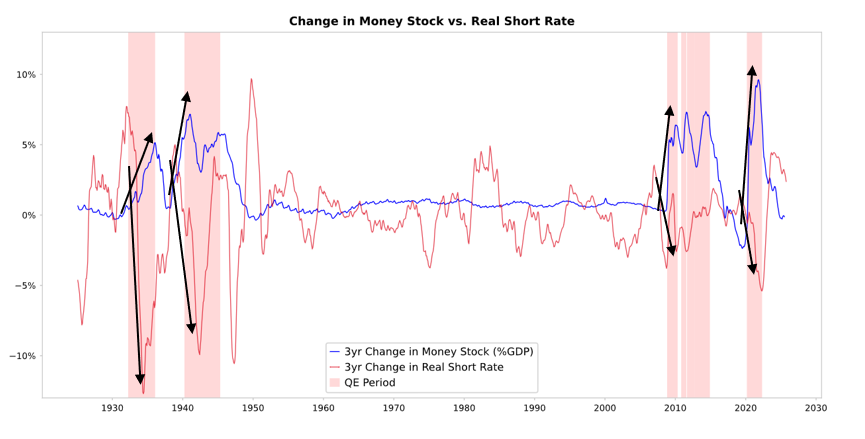
As explained more comprehensively in my book “How Countries Go Broke: The Big Cycle” than I can explain here, all financial flows and market movements are driven by relative appeals rather than absolute appeals. Said simply, everyone has a certain amount of money and credit which central banks influence through their actions, and everyone makes their choices about what to do with it based on the relative appeals of their choices. For example, they can borrow or lend depending on the cost of money relative to the returns they can get for their money, and what they put their money into primarily depends on the relative expected total returns of the alternatives, with the expected total return equaling the yield of the asset plus its price change. For example, the yield on gold is 0% and the yield on a 10-year Treasury bond is now about 4%, so you’d prefer to own the bond if you expect the price appreciation of gold to be less than 4% per year and you’d prefer to own gold if it’s expected to be more than 4%. When thinking about how gold will perform and how bonds will perform relative to that 4% hurdle, one of course should think about what the inflation rate will be because these investments need to pay enough to compensate for inflation that will lower our buying power. All things being equal, the higher the inflation rate, the more gold will go up because most of inflation is due to the value and buying power of other currencies going down due to their increased supply, while there isn’t much increased supply of gold. That’s why I think about the supply of money and credit, which is why I am thinking about what the Fed and other central banks are doing. More specifically, over long periods of time, gold’s value has tracked inflation, and since the higher the level of inflation the less appealing the 4pct bond yield (e.g. a 5pct inflation rate would make gold more appealing supporting gold prices and would make bonds less appealing because it would lead one to have a -1pct real return), the more money and credit central banks are making, the higher I expect the inflation rate to be, and the less I like bonds relative to gold. All else being equal, the Fed’s increased QE should be expected to lower real interest rates and increase liquidity by compressing risk premia, pushing real yields down and pushing P/E multiples up, and especially boosting valuations of long-duration assets (such as tech, AI, growth) and inflation hedge assets such as gold and inflation indexed bonds. Tangible asset companies like miners, infrastructure, real assets would likely outperform over pure long-duration tech once inflation risk re-awakens.
With a lag it should be expected to raise inflation from what it otherwise would have been. If real yields fall because of QE but inflation expectations rise, nominal multiples can still expand, but real returns erode.
It would be reasonable to expect that, similar to late 1999 or 2010-2011, there would be a strong liquidity melt-up that will eventually become too risky and will have to be restrained. During that melt-up and just before the tightening that is enough to rein in inflation that will pop the bubble is classically the ideal time to sell.
While I would expect the mechanics to work as I described, the conditions in which this QE would take place are very different from those that existed when they took place before because this time the easing will be into a bubble rather than into a bust. More specifically, in the past QE was deployed when:
Asset valuations were falling and inexpensive or not overvalued.
The economy was contracting or very weak.
Inflation was low or falling.
Debt and liquidity problems were large and credit spreads were wide.
So, QE was a “stimulus into a depression.”
Today, the opposite is true:
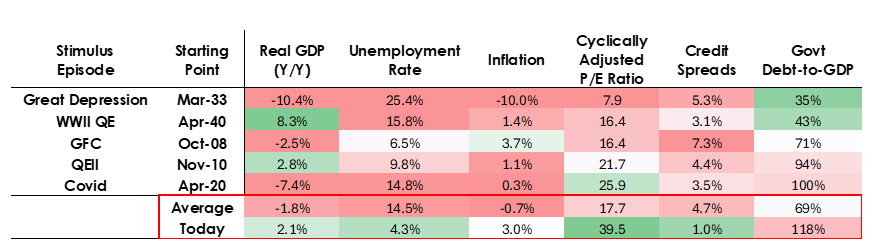
So, QE now would not be a “stimulus into a depression” but rather a “stimulus into a bubble.”
Let’s look at how the mechanics typically affect stocks, bonds, and gold.
Because the fiscal side of government policy is now highly stimulative (due to huge existing debt outstanding and huge deficits financed with huge Treasury issuance especially in relatively short maturities) QE would effectively monetize government debt rather than simply re-liquify the private system. That’s what makes what is happening different in ways that seem to make it more dangerous and more inflationary. This looks like a bold and dangerous big bet on growth, especially AI growth, financed through very liberal looseness in fiscal policies, monetary policies, and regulatory policies that we will have to monitor closely to navigate well.

The government redistributed roughly 6,274 BTC (around $678 million at publication time) from one address into 14 fresh addresses, each capped at 500 BTC, as a precautionary security measure.

The Federal Reserve has initiated its first interest rate cut in nine months, reducing the federal funds rate by 25 basis points to a range of 4.00%–4.25%.

Trust Wallet Token (TWT) is a BEP-20 utility token designed to support growth, loyalty, and user engagement within the Trust Wallet ecosystem. This litepaper describes potential approaches to strategy, distinct utilities, a tiered engagement system, and a roadmap for aligning platform and token utility to enhance the user experience and community participation.

2024 is starting where 2023 left off. Momentum keeps driving crypto forward, with certain pockets benefitting in particular. Let’s dive into these key narratives and what 2024 may have in store for them.
1- Bitcoin ETF Launch – More than 10 years after the first Bitcoin ETF spot application, it appears we are primed for it to launch this month. Multiple applications from some of the largest asset managers are expected to receive a response regarding their approval as soon as today, January 5.

Source: IntoTheBlock’s Bitcoin ETF Perspectives
Will the Bitcoin ETF Finally be Approved? The answer to this question can vary significantly based on the person answering
Is an Approval Priced In? Given the seemingly high odds of approval, is the market move from the ETF already factored in by market participants?
What’s Next? The next week should be interesting as the final decisions are announced
If the ETF is approved, then the market’s attention is likely to shift to whether it’s an initial “sell the news” event first
The next parameter to watch will be just how much volume these ETFs are able to attract within the first days of trading. If these disappoint, there is potential risk for the market, which has been overly optimistic
Regardless of the outcome, the Bitcoin ETFs are likely to continue being a major catalyst affecting crypto in Q1 of 2024
2- Ethereum’s Dencun Upgrade Impact on L2s – After being delayed a few months, Ethereum is on track to deploy its next major upgrade in late Q1 or early Q2. EIP-4844, also known as protodank sharding, is one of the most anticipated changes coming, bringing down transaction costs on layer 2s by 10x or more

Source: IntoTheBlock’s Arbitrum Incentives Program dashboard
Accelerating L2 Growth – The main layer 2s have been seeing sharp growth in prices and key metrics
Arbitrum’s Moment – Although OP has outperformed over the last three months, Arbitrum metrics are showing signs of progress in 2024
Overall, Ethereum’s transition to L2s has been in motion already, and is set to accelerate following the implementation of the Dencun upgrade. As such, the L2 ecosystem and their tokens are a main area of focus going into 2024.
3- Restaking & Liquid Staking – In terms of new products, EigenLayer’s launch is set to be one of the most anticipated releases of 2024. EigenLayer is an infrastructure layer that will enable “restaking”, or using Ethereum’s existing staked funds in order to validate additional features for applications building on top of it. Its launch is set to bring forth new applications, while benefitting the existing liquid staking protocols.

Source: IntoTheBlock’s Ethereum Liquid Staking Perspectives
Impact of Restaking on LSTs – Restaking on EigenlLayer will provide higher yields on top of the existing staking rate
Just a week into the year, chatter around restaking has grown as EigenLayer reached its cap of the amount of ETH staked into the product. Liquid staking projects governance tokens such as LDO have also been favored by the market, appreciating by over 10% year to date. Ultimately, the launch of this new primitive is expected to be one of the key narratives shaping crypto throughout the year.

The Google Play Store, a hub for millions of apps, has been recently targeted by malicious Telegram clones, jeopardizing the security of thousands. These mods, eerily similar to the original and laden with spyware capabilities, pose a substantial threat to individual and business users alike.
Telegram, an encrypted messaging application, allows and encourages the development of “mods” – modified versions of the original software to enhance user experience. While most mods are developed with user benefits in mind, this openness has inadvertently given cybercriminals an opportunity to exploit unsuspecting users.
Masquerading as “faster” alternatives to the conventional Telegram app, these malignant clones have successfully eluded Google Play’s security measures. They predominantly target Chinese-speaking users, with app descriptions available in traditional Chinese, simplified Chinese, and the Uyghur language. A particular subset of these deceptive apps goes by “Paper Airplane,” which entices users with the promise of faster performance, attributing it to a global network of data centers.
The malevolent clones are distinguished from the genuine Telegram app by an embedded module – a powerful spyware that tracks all messenger activities, from collecting contacts to intercepting messages.
The staggering number of downloads – more than 60,000 – highlights the severity of the issue. The Uyghur-targeted version is especially alarming, considering the past surveillance and persecution faced by this ethnic minority by government agencies.
These revelations raise concerns for businesses, especially in light of the growth of mobile spyware and the vast personal and corporate data housed in smartphones. With businesses now leaning heavily on messenger apps for day-to-day communication, such findings serve as a stark reminder of the omnipresent cyber threats.
In response to these findings, Google initiated the removal of these deceptive Telegram clones from its store. Some of these apps had accumulated up to 10,000 downloads before their eventual removal. Nonetheless, concerns persist as not all versions of the malicious apps have been eradicated from the Play store.
Counterfeit apps have long been a staple in the hacker’s toolkit. Recent revelations exposed another scheme where hackers circulated bogus versions of Signal and Telegram through legitimate app stores to implant information-stealing malware. Another spyware-infused version of Telegram, labeled “FlyGram,” was identified on both Google Play and the Samsung Galaxy Store, as was a trojanized version of the Signal app, named Signal Plus Messenger.
Businesses, to safeguard their interests, are being advised to caution employees about the risks of third-party apps, even when sourced from reputed app stores. Users are encouraged to be vigilant, paying attention to details like the developer and negative user reviews, not just the app’s name.

Grayscale Investments, a leading crypto investment firm, recently landed a huge victory in its legal tussle with the Securities and Exchange Commission (SEC) over its proposed Grayscale ETF. A federal appeals court ruled in favor of Grayscale and compelled the SEC to reevaluate its earlier denial of Grayscale’s proposal to convert its Bitcoin Trust, called GBTC, into an ETF. This judgement has sent ripples across the crypto industry, leading to an immediate surge in Bitcoin prices and offering hope for the approval of spot bitcoin ETFs in the U.S.
The legal conflict was initiated when the SEC blocked Grayscale’s attempt to convert its Bitcoin Trust into a Grayscale ETF. Grayscale retaliated by suing the SEC in June 2022, arguing that the SEC had acted arbitrarily in approving ETFs investing in bitcoin futures contracts while rejecting products that aimed to hold bitcoin directly. The three-judge panel of the DC Circuit Court of Appeals sided with Grayscale, ruling that the SEC must review its rejection of Grayscale’s proposal.
The court’s decision signals a monumental step forward for American investors and the wider bitcoin ecosystem. The ruling also raises the prospects of other asset managers winning approval for their products. Following the court’s decision, bitcoin prices rose by more than 5%, exceeding $27,000. This price surge underlines the market’s anticipation and the significant impact such a decision holds.
However, despite this victory for Grayscale, the crypto market isn’t tossing confetti just yet. While some tout this victory as the “next big thing” for the digital currency landscape, the market’s lukewarm response and a mere 7% uptick in Bitcoin’s price post-ruling paint a different story.
The SEC has long been skeptical about approving spot bitcoin ETFs, citing concerns over market manipulation. However, the court’s decision could compel the SEC to reassess its stance, potentially opening the doors for a spot bitcoin ETF in the U.S.

Web3 domains are decentralized domains that are registered and controlled by users on the blockchain. Unlike traditional domains, which are governed by centralized authorities and intermediaries, web 3.0 domains offer more security, privacy, and freedom for users. However, there may be situations where you want to transfer your web3 domain to another wallet or person. In this article, we will explain how and why you may want to do that.
There are two main ways to transfer a web 3 domain: through the Unstoppable Domains website, secondary markets like OpenSea or Rarible or through your own crypto wallet.
Unstoppable Domains is a platform that allows users to buy, sell, and manage web 3 domains. If you have registered your domain on Unstoppable Domains, you can easily transfer it to another wallet or person through their website. Here are the steps to follow:
Secondary markets are platforms that allow users to buy and sell NFTs (non-fungible tokens), which include web3 domains. Some of the popular secondary markets are OpenSea and Rarible. If you want to sell your domain on these platforms, you can list it for sale and wait for buyers to bid or buy it. If you want to buy a domain from these platforms, you can browse through the available domains and make an offer or purchase it directly.
If you want to transfer your domain directly to another person without listing it for sale, you can also do that through these platforms. Here are the steps to follow:
To transfer an ENS domain ownership to another user, you need to go to the ENS Domain Manager and log in with the wallet holding your ENS name. Here are the steps to follow:
After the transaction is confirmed, the ownership of the domain will be transferred to the recipient’s wallet. Please note that any records or settings associated with the domain, such as linked cryptocurrency addresses or website content, would need to be updated separately by the new owner of the domain. Additionally, depending on the specific blockchain and wallet software being used, there may be transaction fees associated with transferring the domain between wallets.
Web3 domains are decentralized domains that are registered and controlled by users on the blockchain. Once a user has minted a domain to their wallet, they have complete control over that domain. This means that Web3 domains can be transferred, updated, and linked to other services without the involvement of Unstoppable Domains or any other centralized authority.
To transfer a Web3 domain from your own crypto wallet to another person’s wallet without using Unstoppable Domains, you would need to initiate a transfer of the domain’s non-fungible token (NFT) from your wallet to the recipient’s wallet. The exact steps for doing this would depend on the specific blockchain and wallet software you are using. You may need to consult the documentation for your wallet or seek assistance from the wallet’s support team to learn how to transfer NFTs between wallets.
It is important to note that transferring a Web3 domain in this manner would only transfer ownership of the domain itself. Any records or settings associated with the domain, such as linked cryptocurrency addresses or website content, would need to be updated separately by the new owner of the domain. Additionally, depending on the specific blockchain and wallet software being used, there may be transaction fees associated with transferring the domain’s NFT between wallets.
There are various reasons why you may want to transfer a web 3 domain. Here are some of them:
Web3.0 domains are a new and exciting way of owning and managing your online identity and presence. However, there may be situations where you want or need to transfer them to another wallet or person. In this article, we have explained how and why you may want to do that using two main methods: through the Unstoppable Domains website or through secondary markets, through ENS and owner’s wallet. We hope that this article has been helpful and informative for you.

In writing texts and copies in WordPress and with the help of Elantor’s page builder, you can click on the multi-star button above or next to the text box and get help from artificial intelligence to write your copy or text.
In the first use of this possibility, you will be directed to the Elementor site to create a user account in Elementor and connect your WordPress site to Elementor.
The simple meaning of the word “Copy” = a piece/text sample from a book or other publication or issue
The AI Elementor Addons are powerful tools that enhance the functionality and capabilities of the Elementor page builder plugin. These AI add-ons utilize artificial intelligence algorithms to provide advanced features, automation, and intelligent recommendations for creating stunning websites. These add-ons save time, enhance user experience, and provide valuable insights for optimizing your website’s performance.
From personalized website-making to smart automation, our AI-powered add-ons revolutionize the way you interact with technology. Open AI GPT is an advanced machine learning model that can generate human-like text, making it ideal for applications such as content creation and chatbots. Integrating Open AI GPT technology in AI addons for Elementor can bring a new level of sophistication and personalization to your website-building experience. Open AI GPT integration can enhance the features of AI add-ons and provide more advanced capabilities for building high-performing, user-friendly websites.
[one_third]
Generate Images
Use Elementor AI’s text-to-image generator to add unique images and fine-tune them to get the look you want.
[/one_third][one_third]
Write Copy and Code
Craft original text, modify or translate it right within the editor. Plus, let AI generate custom code – all at the touch of a prompt.
[/one_third][one_third_last]
Natively Integrated
Accelerate your productivity and instantly generate spot-on content & code without having to switch between different tools.
[/one_third_last]