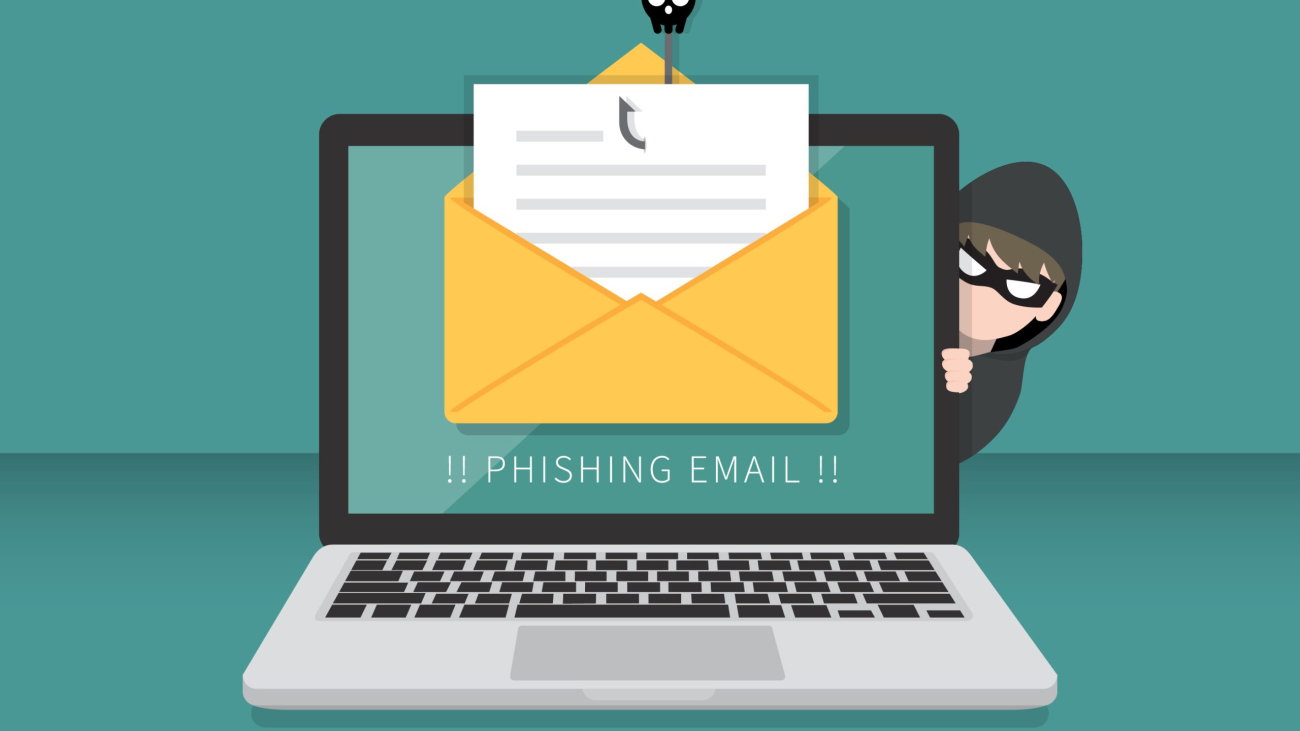
Phishing is an attempt to steal personal information or break in to online accounts using deceptive emails, messages, ads, or sites that look similar to sites you already use. For example, a phishing email might look like it’s from your bank and request private information about your bank account.
Phishing messages or content may:
Ask for your personal or financial information.
Ask you to click links or download software.
Impersonate a reputable organization, like your bank, a social media site you use, or your workplace.
Impersonate someone you know, like a family member, friend, or coworker.
Look exactly like a message from an organization or person you trust.
Avoid phishing messages & content
To help you avoid deceptive messages and requests, follow these tips.
1. Pay attention to warnings from Google
Google uses advanced security to warn you about dangerous messages, unsafe content, or deceptive websites. If you receive a warning, avoid clicking links, downloading attachments, or entering personal information. Even if you don’t receive a warning, don’t click links, download files, or enter personal info in emails, messages, webpages, or pop-ups from untrustworthy or unknown providers.
2. Never respond to requests for private info
Don’t respond to requests for your private info over email, text message, or phone call.
Always protect your personal and financial info, including your:
Usernames and passwords, including password changes
Social Security or government identification numbers
Bank account numbers
PINs (Personal Identification Numbers)
Credit card numbers
Birthday
Other private information, like your mother’s maiden name
Tip: Only give out contact info like your email address or phone number to a website if you’ve confirmed it’s reputable. Don’t post your contact info on public forums.
3. Don’t enter your password after clicking a link in a message
If you’re signed in to an account, emails from Google won’t ask you to enter the password for that account.
If you click a link and are asked to enter the password for your Gmail, your Google Account, or another service, don’t enter your information, go directly to the website you want to use.
If you think a security email that looks like it’s from Google might be fake, go directly to myaccount.google.com/notifications. On that page, you can check your Google Account’s recent security activity.
4. Beware of messages that sound urgent or too good to be true
Scammers use emotion to try to get you to act without thinking.
Beware of urgent-sounding messages
For example, beware of urgent-sounding messages that appear to come from:
People you trust, like a friend, family member, or person from work. Scammers often use social media and publicly available information to make their messages more realistic and convincing. To find out if the message is authentic, contact your friend, family member, or colleague directly. Use the contact info you normally use to communicate with them.
Authority figures, like tax collectors, banks, law enforcement, or health officials. Scammers often pose as authority figures to request payment or sensitive personal information. To find out if the message is authentic, contact the relevant authority directly.
Tip: Beware of scams related to COVID-19, which are increasingly common. Learn more about tips to avoid COVID-19 scams.
Beware of messages that seem too good to be true
Beware of messages or requests that seem too good to be true. For example, don’t be scammed by:
Get rich quick scams. Never send money or personal information to strangers.
Romance scams. Never send money or personal info to someone you met online.
Prize winner scams. Never send money or personal info to someone who claims you won a prize or sweepstakes.
5. Stop & think before you click
Scammers often try to deliver unwanted software in links through email, social media posts or messages, and text messages. Never clicks links from strangers or untrustworthy sources.
Gmail is designed to help protect your account by automatically identifying phishing emails. Look out for warnings about potentially harmful emails and attachments.
Note: Gmail won’t ever ask you for personal information, like your password, over email.
When you get an email that looks suspicious, here are a few things to check for:
On a computer, you can hover over any links before you click on them. If the URL of the link doesn’t match the description of the link, it might be leading you to a phishing site.
To get notified if you enter your Google Account password on a non-Google site, turn on Password Alert for Chrome. That way, you’ll know if a site is impersonating Google, and you can change your password if it gets stolen.
When we identify that an email may be phishing or suspicious, we might show a warning or move the email to Spam. If an email wasn’t marked correctly, follow the steps below to mark or unmark it as phishing.
Important: When you manually move an email into your Spam folder, Google receives a copy of the email and any attachments. Google may analyze these emails and attachments to help protect our users from spam and abuse.
Look at the chart of the native token for nearly every Decentralized Exchange (DEX), and you’ll see a familiar pattern: pump followed by, wait for it, dump.
The household name DEXs like Uniswap, Sushi, and even TraderJoe are alive and well despite the lackluster price action of their tokens, but many other DEXs have faded into oblivion. Exchanges you’ve probably never heard of like Smoothy Finance and LuaSwap managed to attract short-lived liquidity, but as their generous incentives for liquidity providers dried up, mercenary LPs dumped the native tokens they got for free and, critically, they proceeded to move their liquidity back to where the volume is (ie. the household names). This was a double blow for the DEXs they sucked dry; when both Total Value Locked (TVL) and token price tank, the result is a death spiral.
Observe the TVL and price action for the above-mentioned Smoothy Finance (SMTY) and LuaSwap (LUA):
Market share of DEXes by volume (https://dune.com/queries/4319/8411)
The DEX space is dominated by a few giants like Uniswap and Curve, but littered with the remains of many short-lived contenders like Smoothy Finance and LuaSwap. Note that Uniswap (pink) and Curve (green) account for over 75% of DEX volume.
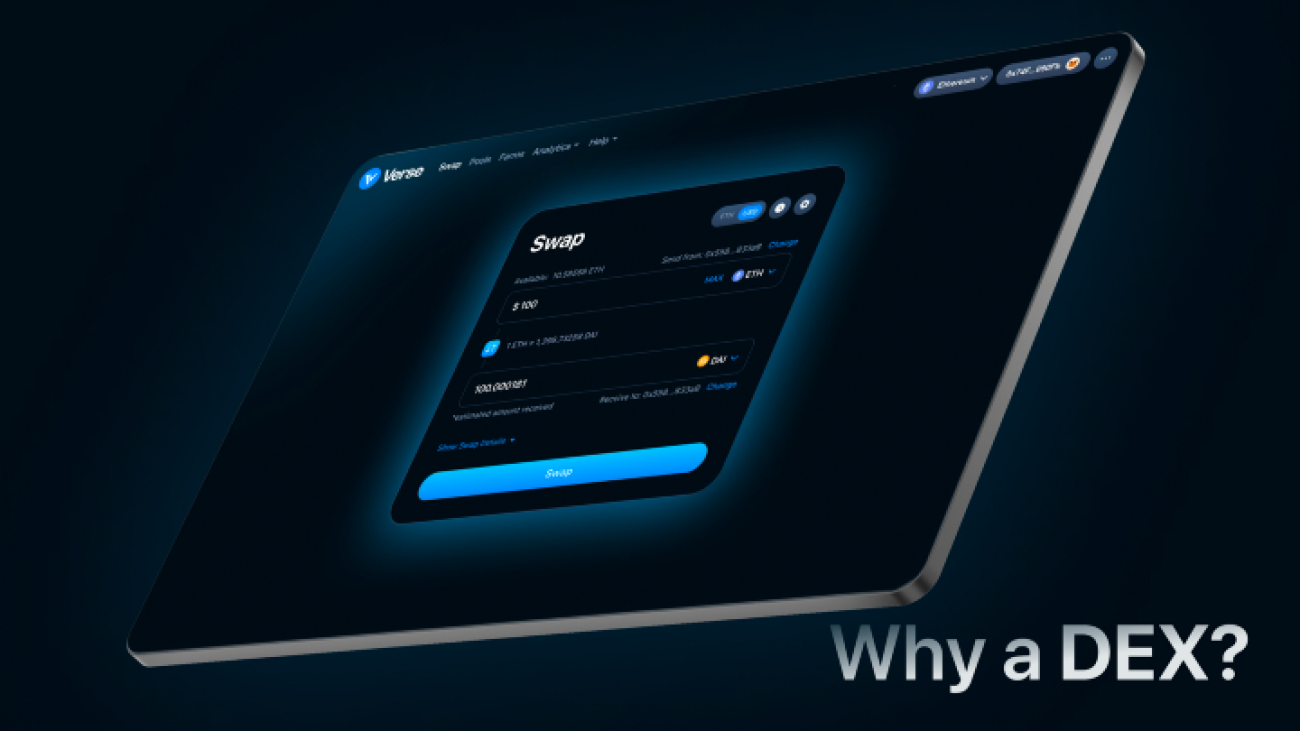
Why then, would Bitcoin.com launch the Verse DEX? How can Bitcoin.com’s DEX succeed where so many others have failed, and how can it compete against already well-established DEXs?
To answer this question, we’ll first explain why Bitcoin.com’s Verse DEX will succeed. After that, we’ll go into the reasons for launching a DEX (ie. the advantages the Verse DEX brings to the Bitcoin.com ecosystem).
Why Verse DEX will succeed
Every other new-DEX-on-the-block must find ways to attract and retain both liquidity and users, but the Verse DEX does not have this problem.
By far the most common approach for attracting liquidity has been to give away tokens to liquidity providers. Once the liquidity is there, you have a useable product — but that’s just the first step.
Now you need users. Bots will naturally trade the pairs in your exchange, but what you really need for long-term sustainability is human users (humans are sticky). Assuming aggregators have you on their radar and your exchange is competitive in terms of fees/depth, a certain number of real users will have their orders routed through your exchange without you having to spend a dime on marketing. Of course, this only lasts as long as those sweet incentives keep flowing. Also, users who find you through aggregators may not even notice you since, in most cases, you’ll be hidden in the UX.
To make your exchange sustainable in the long run, you’ll need to find a way to keep both the liquidity and the users. The only way the liquidity will stay without the incentives is if the users are there (LPs earn a share of trading fees, which means volume must be high). So, you might try marketing; perhaps an airdrop to get your name out there? This worked for Uniswap and to a lesser extent Sushiswap, but good luck finding a spot in the sun now that those giants are already sprawled out on the beach. And by the way, the same scenario has already played out on every other L1.
It’s the users
This brings us to the single biggest advantage Bitcoin.com has: users. Millions of people self-custody their crypto using the Bitcoin.com Wallet. The vast majority of them are relative newcomers to the space, and they are itching to do something with their crypto. For example, many would like to swap between the marquee cryptos they own, adjusting their portfolio in line with the shifting trends in the crypto space. Others would like to invest in up-and-coming projects (see Verse Launchpad), pick up some NFTs, enjoy Play&Earn games, and so on. Via integrations to Bitcoin.com’s products, the Verse DEX will be at the fingertips of these people, providing essential infrastructure for their crypto/web3 journey.
Wallet owned liquidity
As for the other side of the equation, liquidity, the answer there is two fold and can be crystalized in a concept we like to call “wallet owned liquidity.”
Bitcoin.com itself, as well as select strategic partners, will provide the initial liquidity to get the ball rolling. Bitcoin.com knows exactly what our users want to trade, which means we can focus liquidity on those pairs. Note that to provide liquidity to the Verse DEX, Bitcoin.com can use not only the VERSE tokens we receive along the Verse emissions schedule, but we can also dedicate resources from other parts of our ecosystem. This includes revenue generated from our buy and sell (with fiat) services, our news service, and our games sub brand. All of this is to say that we don’t need to offer unsustainable incentives in order to provide sufficient liquidity to the Verse DEX, neither at launch nor over the long term. Importantly, having diverse revenue sources also means the Verse DEX isn’t susceptible to the death spiral that occurs when TVL and token price fall at the same time.
Our users will also contribute liquidity. Bitcoin.com is known for making user-friendly products. This of course extends to our Verse DEX LP dashboard which will soon be integrated into the Bitcoin.com Wallet, making it simple for even newcomers to allocate capital to the DEX and earn a share of generated fees for doing so. This also creates a nice synergy where, as users become owners of the products they use, they will not only continue to use those products, but also become advocates.
Why not just aggregate ala MetaMask?
Since MetaMask started offering swaps to its millions of users, it has managed to generate at least $200 million in revenue. This is an excellent business model, and it’s certainly something Bitcoin.com is actively exploring — but having a DEX and offering an aggregation service are not mutually exclusive. We can and will do both! Importantly, by building our own DEX, we’re able to pass on the savings to our users for the trading pairs we focus on, while routing transactions elsewhere where it makes sense to do so.
How the Verse DEX improves Bitcoin.com’s offerings
Verse is a gateway to DeFi for Bitcoin.com’s millions of users, and the Verse DEX is the foundation of that gateway. Integrating a DEX right into our mobile and desktop apps makes it easier for us to offer newcomers the opportunity to get into DeFi by putting up some collateral and earning a share of fees. As mentioned, the DEX will also be the jumping off point for everything else in DeFi including NFTs, games, and whatever else is just over the horizon in this fast-moving and innovative space. There are many ways our users can benefit from DeFi, and the Verse DEX will be critical in enabling them.
Finally, the DEX creates synergy. It does this in two ways:
First, revenue generated via the Verse DEX provides additional resources that Bitcoin.com can use to support and expand our ecosystem. It’s important to note here that fees paid on the Verse DEX do not accrue directly to Bitcoin.com. Instead, as explained in the Verse white paper, LPs will earn 0.25% of trading volume. Bitcoin.com, as a large holder of VERSE and significant liquidity provider to the Verse DEX, will simply earn its proportional share of fees as per the protocol — and those fees can be directed to supporting and expanding our ecosystem.
Second, having our own DEX means that, for projects that align with Bitcoin.com’s mission to create economic freedom in the world, we can offer a place to start trading of the associated token. Where there’s opportunity to bring additional value to our users, this will lead to partnerships and integrations with our other products.
In summary, while succeeding in the crowded DEX space is a challenge, it’s not an insurmountable one if you bring your own users to the game and have a range of liquidity sources at hand. For Bitcoin.com specifically, running our own DEX brings a range of benefits to our users while paving a wide avenue to expand our ecosystem further into the DeFi realm.
What. A. Week. The world’s third largest crypto exchange just went belly up, and the industry’s white knight got dragged down in the process. Grab a (Irish) coffee, and let’s figure out what the hell happened and what the implications are.
Sam Bankman-Fried (SBF) is the CEO of FTX, one of the world’s largest exchanges and also principal shareholder of Alameda Research, a separate trading firm he founded prior. There is also an entity called FTX.US. FTX.US is operated as a distinct U.S. operation, separate from FTX with SBF again acting as a principal though not overseeing day-to-day operations. FTX has received funding from big names like BlackRock, SoftBank, Temasek, Tiger Global, and the Ontario Teachers’ Pension Plan. FTX was also a large investor themselves through FTX Ventures, making over 60 individual investments.
FTX has an exchange token called FTT which can be used for benefits on FTX like lower fees and cheaper withdrawals. It is also considered pseudo-equity as a third of the revenue generated on the exchange is used to buyback and burn FTT, tying its price to the success of FTX.
The relationship between FTX and Alameda was always a bit unclear for outside parties, as SBF obviously played a pivotal role in the direction of the two distinct entities.
The trouble began when Coindesk reported on November 2 that Alameda’s assets (~$6 billion of the ~$15 billion) were in FTX’s FTT token. This amount of balance sheet concentration, the fact that it was largely illiquid (representing ~2x the circulating supply of FTT), and the link between the two entities caused immediate market concern. SBF made the link even more dubious by promoting the token on Twitter as recently as Halloween.
On November 6, Binance CEO Changpeng “CZ” Zhao announced that his exchange would liquidate $2.1 billion worth of FTT. Alameda offered to buy it at the market price of $22. CZ publicly seemed to decline…and so did FTT. Sharply.
With the price of FTT rapidly declining, concerns arose about FTX’s growing liquidity concerns and whether user funds were backed. About $6 billion was withdrawn in 72 hours before withdrawals were halted on the afternoon of November 8. Later that day Binance agreed, in principle, to acquire FTX and stem any liquidity concerns. However, after reviewing the FTX balance sheet, they have since walked away from the deal citing “the issues are beyond our control or ability to help.” They also explicitly cited “reports regarding mishandled customer funds and alleged U.S. agency investigations” as other reasons.
Just this morning (November 10) SBF released a statement blaming an internal error of tracking user margins for the liquidity crunch. He said FTX would spend the week trying to raise liquidity from investors and all funds will hopefully be returned to users. We’ll see.
Ray Dalio explained in his LinkedIn about the four big threats that should create worry and the one big force that should create optimism. The four big threats are the financial/economic threat, the internal conflict threat inside the US, the external conflict threat, and the acts of nature threats (drought, floods, pandemics, etc.) and the one big force that provides reasons for optimism is man’s capacity to adapt and invent ways of improving things.
While these threats exist, the world is in the best position in history judging by most measures of well-being such as life-expectancy, real incomes, and real wealth, so if we handle these big worries well, things should be better than ever. Of course, averages hide the differences which are enormous, but the capacity to deal with these extreme differences exists, so the potential to have the best times ever exists if we can deal with the four big threats well.
To have better times than ever we need to:
Get our finances in order through a mix of a) being more productive by investing in those things that make us more productive and benefit most people (such as education), and b) engineering a “beautiful deleveraging” that spreads out and reduces the real debt liabilities and assets relative to real incomes. (If you want an explanation of how to engineer a beautiful deleveraging, see his book Principles for Navigating Big Debt Crises).
Develop a strong and smart political middle that represents the majority of people and can defeat the extreme populist minority so that we can work and live well together. Because the policies that the majority of people want are both most acceptable and more sensible than the policies that the extremists are fighting for, it should not be all that difficult to put together a platform that represents what the majority in the middle wants.
How would such bipartisanship work? For elections it can occur in a variety of ways. As for governing, it can occur in a number of ways if leaders want it, such as the next president of the US choosing to have a bipartisan Cabinet of smart people and to initiate a bipartisan “Manhattan Project” type initiative to make economic reforms that would both significantly improve productivity and benefit the majority of people.
Have rival countries develop agreements and protocols that would minimize the chances of military wars. This could involve having each leader delegate teams to look at the existential threats posed by other nations and negotiate paths for minimizing the risk of fighting over them. If parties could work on minimizing the existential risks of the other parties, that would go a long way to avoiding wars.
As for acts of nature, Ray Dalio will defer to others more knowledgeable than he is to suggest ways to cost-effectively deal with them.
As for man’s ability to adapt and invent, he thinks that is naturally happening in the greatest way ever. That’s because of the development of technologies that help people think about how to make such improvements and because of the development of venture capital markets to finance entrepreneurs with good ideas in numbers and amounts that are unprecedented.
While we might think that the odds of doing these things are improbable, they are certainly possible and could even become probable if most people demanded that their leaders and political parties move in directions like these.
The Web3 Domain Alliance is a member-led, member-driven organization dedicated to improving the technological and public policy environments for users of blockchain naming services.
W3DA Missoin
This alliance to promote the development of the blockchain naming ecosystem and the functioning of blockchain domain registries with and across blockchain-based and traditional web applications.
The Web3 Domain Alliance is dedicated to the technological advancement of blockchain domain registries, as well as consumer protection by ensuring the interoperability of blockchain domain registries.
The Web3 Domain Alliance believes that blockchain-based generic web3 Top Level Domains (“TLDs”) developed and marketed by a specific organization are intellectual property, and that industry participants should respect the intellectual property rights of all blockchain naming services for the benefit of consumers as well as applications that want to support blockchain domain functionality.
W3DA Pledge
As a member of the Web3 Domain Alliance, companies pledge the following:
To abide by the Web3 Domain Alliance’s principles of developing unique, interoperable blockchain domain namespaces, NFT domains, and advocating for the legal protection and market acceptance of blockchain namespace.
To protect users and endeavor toward the development of interoperable NFT domain naming systems by promoting voluntary avoidance of namespace collisions with existing Web3 naming systems in the Web3 domain industry.
To advocate for the policy position that NFT domain registry owner-operators create trademark rights in their web3 TLDs through first commercial use with market penetration.
To protect our intellectual property rights, including trademark rights, in our web3 TLDs.
To work with fellow Web3 Domain Alliance members to promote the advancement of the Web3 Domain Alliance’s policy positions.
To work with fellow Web3 Domain Alliance Members to advocate for recognition of NFT domains by a broad community of stakeholders, and the public.
Hivemapper is building one of the first on-chain, decentralized global maps powered completely by the people. Since launch in November 2022, the Hivemapper network has significantly grown its active contributor base and map coverage.
Over 301,000 unique kilometers have been added to the network’s decentralized map in the past 3 months. Most of the map is congested around major metropolitan areas such as Los Angeles and Seoul. Additionally, the daily average of unique mapping contribution has increased by 4.5x since January, largely due to the steadily rising number of network contributors.
The total unique user base has grown by 30x since November to nearly 6,300 users. This metric comprises 30% mapping contributors, 69% quality assurance (QA) contributors, and <1% data users. Mapping contributors are particularly important because they actively trace roadways with a Hivemapper dashcam. The growth of this user segment is directly correlated with the Hivemapper team’s dashcam production, which has been increasingly catching up to their evergrowing waitlist.
QA contributors verify contributions from dashcam footage. Both the mapping and QA contributors receive the platform’s native HONEY token in exchange for their contributions. The combined efforts of these contributors will ideally create a comprehensive, high-quality, and up-to-date map of the world.
Finally, data users query the network’s API for external usage. Enterprises and developers can purchase map credits — fixed at $0.02 USD — that can be used to query map data. As users consume map imagery, a corresponding amount of the HONEY token is burned. Then, an equivalent number of HONEY tokens is added back to complete Hivemapper’s net emission model.
Current Usage
Currently less than 1% of the world’s roadways have made their way onto Hivemapper’s network. As such, it’s not terribly surprising that there is very little usage of Hivemapper’s map data since launch. The network needs to expand its mapped territory before it can incentivize external application development. So how long will it take before the Hivemapper team has a usable dataset?
Let’s look at Los Angeles, one of the most active cities in terms of mapping contributors. According to the global contribution metrics over the past two months, each mapper contributes an average of 10 unique kilometers per day. The city currently boasts 120 mappers, with about 15% of the 134,000 total kilometers mapped.
Assuming no new contributors are added and that contributors prioritize mapping previously untouched areas, LA will have a functioning map in approximately 3 months. Granted, this timeline is a rough estimate that ignores several key details involved in how map footage is sourced, vetted, and approved. However, if the same logic can be applied to other active urban areas, then developers could potentially start building on Hivemapper’s network within the year.
Mapping Economy
Billions of people around the world depend on maps each day. Maps are used by insurance providers, real estate services, logistics companies, navigation and delivery apps, and governmental organizations, just to name a few. Maps are an essential part of the world’s technology infrastructure and represent a $300B market.1
The Problem
Today, global maps are largely controlled by a few companies because they are extremely expensive to build. This has led to numerous problems with today’s maps:
High costs for businesses: The cost of mapping APIs continues to increase due to the lack of competition.2
Uneven freshness and coverage: These maps are not as fresh as they should be due to the incredible expense required to build and maintain them. Developing markets have vastly inferior maps given that the high cost to map breaks the economic models.
Free use of user data: Existing maps use our private and sensitive location data to improve their own maps without compensation.
Prone to censorship: Big tech companies operate a wide set of businesses in many countries, and are often forced to censor or modify their maps to satisfy politicians and land owners.
The Benefits of Building a Mapping Network on the Blockchain
Blockchain and crypto incentives solve these problems by dramatically reducing the cost to map on a global scale, while rewarding contributions to the map and promoting freshness and uncensored quality.
High quality 4K dashcams are widely available for only hundreds of dollars and can be connected to software for efficient collection of 4K street-level imagery. Map QA reviewers, annotators, and annotation QA reviewers are incentivized with ownership to maintain the quality of the map. Additionally, thanks to the decreasing cost of machine vision compute cycles it is now feasible to transform imagery to valuable map data on a global scale.
Imagine a network of map contributors and map consumers intricately connected on a blockchain, participating in the exchange of valuable map data. Map contributors build and refresh the map by capturing 4K street-level imagery, carrying out quality assurance, and annotating imagery. Map consumers leverage the map via a set of APIs such as images, direction, geocoder, and more.
Hivemapper’s decentralized global map and cryptocurrency
The Hivemapper Network is a system that incentivizes map coverage, freshness, and quality with ownership. By installing a simple 4K dashcam on a car or truck, a contributor can earn a new cryptocurrency, own part of the decentralized global map, and support the world’s critical geospatial infrastructure in a cost-effective way.
Powering the Hivemapper Network is the decentralized global map on the blockchain and its cryptocurrency HONEY . With the introduction of a decentralized mapping network and cryptocurrency, the mapping network injects decentralization and built-in crypto incentives into an industry currently controlled by monopolies and governments that take our data for free. The result is a state-of-the-art map of our world that is constantly-renewing, high quality, truly covers our whole world, and is collectively owned by its contributors.
Fig. 1 / The Hivemapper Network – This diagram shows the two-sided marketplace between map contributors and map consumers interacting on the Hivemapper Network with its cryptocurrency token HONEY.
System Overview
Map Tiles
The global map is divided into small hex shaped tiles referred to as map tiles. The map tiles are the atomic unit of the map and based on H3 cells. We intentionally use small H3 cells as the basis for our map tiles (shown in the graphic below) to make it easy to start contributing and to avoid issues with “partial” tiles contributed.
Fig. 2 / Map Tiles – Map tiles are the atomic unit of the Hivemapper map that contributors use to build and refresh coverage. Each map tile is hex shaped. Trillions of these hex shaped tiles cover the entire earth.
4K Street-Level Imagery to Map Tiles
The 4K street-level imagery and related GPS metadata collected with approved dashcams and the Hivemapper app serve as the raw ingredients for the global map. This data provides coverage for map tiles as seen in Figure 3 below.
Fig. 3 / Map Tiles Along a Path – Map tiles that have been covered on the road are represented in pink, as shown by H3 cells.
Map Contributors
The collective work of map contributors on the Hivemapper Network results in a high quality global map. The chart below details the different types of map contributors and the type of work they do on the mapping network.
Contributor
Work They Do
Drivers
Collect 4K street-level imagery via a supported 4K dashcam and Hivemapper app
Imagery QA Reviewers
Validate the 4K street-level imagery collected by drivers
Annotators
Annotate the map with details such as street direction and name. Annotations can be broadly defined; for example, a customer may pay to add artwork associated to the map
Annotation QA Reviewers
Validate the work of Map Annotators
Software Developers
Extend the protocol, product, and work on core mapping features and the Hivemapper app
The Hivemapper Dashcam
Fig. 4 / Hivemapper Dashcam – The Hivemapper Dashcam is an open source camera based on the Open Dashcam specifications that is optimized for collecting imagery from a vehicle for the purpose of mapping.
In the summer of 2022, Hivemapper will begin selling the world’s first crypto-enabled dashcam. The Hivemapper Dashcam is an open source dashcam that natively integrates with the Hivemapper Mapping Network through a seamless mobile app.
The Hivemapper Dashcam is based on the Open Dashcam specifications that ensures:
Location Authentication: Multiple layers of security to ensure that the dashcam is authentically geolocating its position
Automatic data transfers: Automatically transfers the collected data from the dashcam to the Hivemapper Network via integration with the Hivemapper Contributor App for iPhone and Android
Dynamic data collection: Dynamically determines the data required for the map – ignores the rest
These capabilities make it the ideal dashcam for mapping on a decentralized network.
Hardware manufacturers can incorporate the Open Dashcam specifications in their own dashcams, and seek approval from the Hivemapper Foundation to run their compliant dashcams on the mapping network.
Honey Token
HONEY is the Hivemapper cryptocurrency of the decentralized mapping network. The Hivemapper Network is built on top of the Solana blockchain.
Map contributors mine HONEY by contributing to the Hivemapper Network. A fixed number of HONEY tokens are minted decreasingly over time. The maximum number of HONEY tokens that will ever exist is 10 billion.
Map API Services
APIs built on top of the global map enable developers to cost effectively integrate maps and geolocation services into their applications. Today, Hivemapper Inc. offers individuals and organizations the powerful Map Image API. The set of APIs that Hivemapper Inc. and other organizations can build and commercialize on top of the global map includes Driving Directions, Geo Search, Traffic, and more.
The Hivemapper Foundation ensures that any company or organization can build and commercialize API services on top of the global map.
Map Consumers
Customers who want to integrate Hivemapper’s map APIs into their applications can purchase API calls with Map Credits. Map Credits are created by burning HONEY tokens, ahead of any use of map APIs. These burned tokens then increase the number of tokens available to mint and to pay to map contributors.
The Burn and Mint Equilibrium
The Burn and Mint Equilibrium with Net Emissions model is used, such that whenever map consumers burn tokens to access the network, an equivalent number of tokens is added back into the rewards pool for map contributors as shown in Figure 5 below.
Fig. 5 / The Burn and Mint Equilibrium – When map consumers use map APIs this transaction burns tokens, and an equivalent number of tokens is added back into the pool to reward contributors.
At a high level, contributors, including drivers, annotators, and QA reviewers, build the database of fresh and accurate map data in exchange for HONEY. Consumers of the data pay into the network by purchasing and burning tokens to compensate the contributors for their work.
Future Areas
Today, the mapping network focuses on street level maps. Next, the network will introduce map annotations enabling map editors to edit the map alongside the machine learning algorithms to add new layers of data to the map.
Yet, this is just the beginning. Global data collection for a global map, incentivized by the HONEY cryptocurrency token and protocol, is the right approach to building a global map. With this in mind, there are multiple technologies that hardware and software developers can use to add additional layers to the global map in order to meet the needs of customers:
Additional imagery sensors such as 360 cameras from street level
Support for collecting imagery from scooters and bikes to support high quality maps for alternative transportation modalities
Use of air quality sensors to incorporate air quality data into the map
Use of lower cost RGB-D, radar, and LiDAR sensors to build 3D maps and street level object mapping
Airborne data collection via drones to provide the high precision aerial perspective
Use of satellite imagery for a broad scale aerial perspective
Based on Messari’s announcements, its author(s) may hold cryptocurrencies named in their report, and each author is subject to Messari’s Code of Conduct and Insider Trading Policy. Additionally, Messari’s employees are required to disclose their holdings, which are updated monthly and published here. This report is meant for informational purposes only. It is not meant to serve as investment advice. You should conduct your own research, and consult an independent financial, tax, or legal advisor before making any investment decisions. Messari does not guarantee the sequence, accuracy, completeness, or timeliness of any information provided in this report. Please see Messari’s Terms of Use for more information.
Download the PDF for Messari authors crypto holdings as of Sept. 30, 2022 below:
Browse privately. Search privately. And ditch Big Tech.
Stop being followed online
By default, Brave blocks the trackers & creepy ads on every website you visit. And that thing where ads follow you across the Web? We block that, too.
Online privacy made simple
All the good of ad-blocking, incognito windows, private search, even VPN. All in a single download.
Switch in 60 seconds
Quickly import bookmarks, extensions, even saved passwords. It’s the best of your old browser, only safer. And it only takes a minute to switch.
The new super app
Brave brings truly independent search, free video calls, offline playlists, even a customizable news feed. All fully private. All right to your browser super app.
Privacy you can see
No creepy ads & trackers means less stuff (visible or hidden) on the sites you visit. And that means faster page load, better battery life, even mobile data savings.
Online privacy by default: Brave vs. other browsers
Advanced features
Only here for the privacy? We got you. Just download and enjoy…
Want a more bespoke experience? Brave’s got great customizations, too:
Advanced security
Built-in IPFS integration, onion routing with Tor, custom filter lists, and more security features.
Brave Rewards
Earn crypto tokens for your attention by opting in to privacy-preserving, first-party ads.
Crypto wallet
A secure, browser-native wallet to buy, store, send, and swap your crypto assets.
Is the Brave Browser safe?
Brave is one of the safest browsers on the market today. It blocks privacy-invasive ads & trackers. It blocks third-party data storage. It protects from browser fingerprinting. It upgrades every webpage possible to secure https connections. And it does all this by default.
It’s also built off the open-source Chromium Web core, which powers browsers used by billions of people worldwide. This source code is arguably vetted by more security researchers than any other browser. In short, not only is Brave safe to use, it’s much safer than almost any other browser. Learn more.
How do I download & install Brave?
Brave is available on nearly all desktop computers (Windows, macOS, Linux) and nearly every mobile device (Android and iOS). To get started, simply download the Brave browser for desktop, for Android, or for iOS.
Does Brave have a VPN?
Yes! Brave Firewall + VPN protects everything you do online, on your entire device, even outside the Brave Browser. It’s currently available for Android and iOS mobile devices, and will be available on desktop in the very near future.
What languages is Brave available in?
The Brave Browser is available in nearly 160 languages in all, including four different dialects of Chinese. Brave Search is currently available in English, French, German, Japanese, and Spanish, with support for many more languages coming soon.
Who owns Brave?
The Brave Browser, Brave Search, and all their various features are made by Brave Software Inc, an independent, privately-held company. Brave is not beholden to any other tech company, and works every single day to fight Big Tech’s terrible privacy abuses. Brave exists to help real people, not some faceless tech company.
Is Brave open source?
Yes. The Brave Browser is built on the open-source Chromium Web core and our own client code is released under the Mozilla Public License 2.0.
How does Brave compare to Chrome?
Simply put, the Brave Browser is 3x faster than Google Chrome. By blocking all privacy-invading ads & trackers by default, there’s less stuff to load on every single webpage you visit. That means pages load much faster, saving you time, money, and battery life. It also means you’re much safer online. Learn more.
Is Brave free?
Yes, Brave is completely free to use. Simply download the Brave browser for desktop, for Android, or for iOS to get started. You can also use Brave Search free from any browser at search.brave.com, or set it as your default search engine.
BAT is short for Basic Attention Token. BAT is a crypto asset, and a key (but totally optional) part of the Brave Rewards ecosystem. Here’s how it works:
Brave Rewards gives you the option to view first-party, privacy-protecting ads while you browse (these ads are from the Brave Private Ads network). If you choose to view them, you earn BAT, via the Brave Rewards program.
You can keep BAT like any other crypto asset, or use it to tip the content publishers you love. Brave even gives you a secure way to store BAT (and any other crypto asset), with Brave Wallet. And, again, Brave Rewards is a totally optional program.
Other tech companies steal your data to sell ads—to them, you are the product. Brave is different. We think your attention is valuable (and private!), and that you should get a fair share of the revenue for any advertising you choose to view. That fair share is rewarded in BAT.


, click More
.